
Earning AED 2,500 a month in the UAE and trying to get a personal loan? You’ve probably already faced rejection — or seen the dreaded line: “minimum salary AED 5,000 required.” That’s frustrating, especially when an unexpected expense, a family emergency, or a one-off big purchase is staring you in the face.
Here’s the deal: traditional UAE banks don’t openly approve personal loans on a 2,500 dirham salary. But that doesn’t mean you’re out of options. This guide explains exactly where you stand, what realistic alternatives exist, how to slowly build eligibility, and how to avoid the loan scams that target low-salary workers. Let’s break it down.
Quick Answer
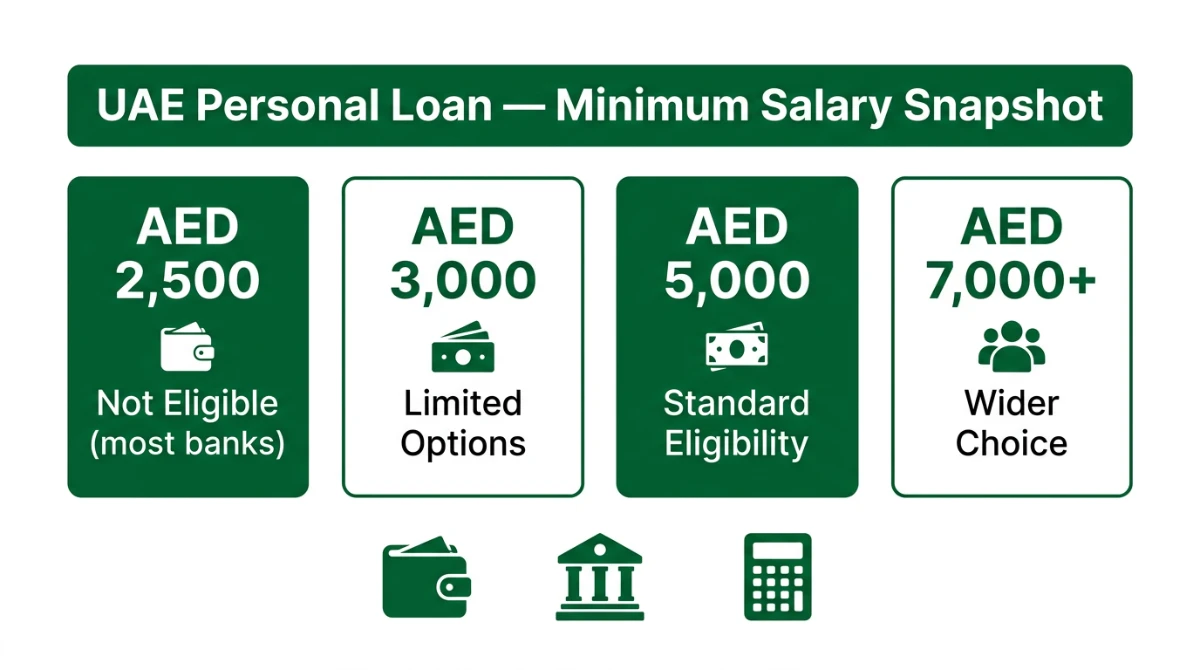
No mainstream UAE bank approves a personal loan on a salary of AED 2,500. Most require AED 5,000 minimum, with a few starting at AED 3,000–4,000 in special cases. Workers earning AED 2,500 should consider salary advances from employers, BNPL services, licensed instant loan apps, or applying with a co-borrower.
Why AED 2,500 Falls Below the UAE Loan Cut-Off
UAE banks calculate loan eligibility around a Debt Burden Ratio (DBR) — your total monthly EMIs cannot cross 50% of your income, as per UAE Central Bank rules. On AED 2,500, that leaves only about AED 1,250 per month for any loan repayment. After basic living costs in Dubai, Sharjah or Abu Dhabi, that margin is too thin for banks to comfortably lend.
This is why the AED 5,000 minimum became the industry baseline. It gives banks enough buffer to manage default risk on unsecured personal loans.
Minimum Salary Rules Across UAE Banks
Below is a clean snapshot of typical minimum salary thresholds for personal loans across major UAE lenders. These figures move with policy changes, so always verify on the bank’s own page before applying.
| Bank / Lender | Typical Minimum Salary | Salary Transfer | Best For |
|---|---|---|---|
| Emirates NBD | AED 5,000 | Usually required | Mainstream expat loans |
| Mashreq | AED 5,000–7,000 | Both options | Digital onboarding |
| FAB (First Abu Dhabi Bank) | AED 7,000 | Required for low rate | UAE nationals & expats |
| ADCB | AED 7,000 | Required | Quick approval |
| Dubai Islamic Bank | AED 7,000 | Required | Sharia-compliant finance |
| HSBC / Citibank / SCB | AED 7,500–10,000+ | Required | Higher loan amounts |
| Deem Finance | AED 5,000 | Not required | Non-salary transfer borrowers |
For a deeper bank-by-bank breakdown including salaries from AED 3,000–5,000, see our linked guide on the UAE salary calculator and personal loan eligibility.
Is There Any Bank That Approves AED 2,500 Salary?
Realistically, no major UAE bank publicly advertises a personal loan starting at AED 2,500. Some smaller finance companies and microfinance lenders may consider profiles below AED 5,000, but conditions are strict and interest rates are far higher than mainstream banks.
If you see an ad promising a guaranteed loan on 2,500 dirhams, treat it as suspicious. Verify the lender against the UAE Central Bank’s licensed list before sharing any document.
Smart Alternatives for AED 2,500 Salary Earners
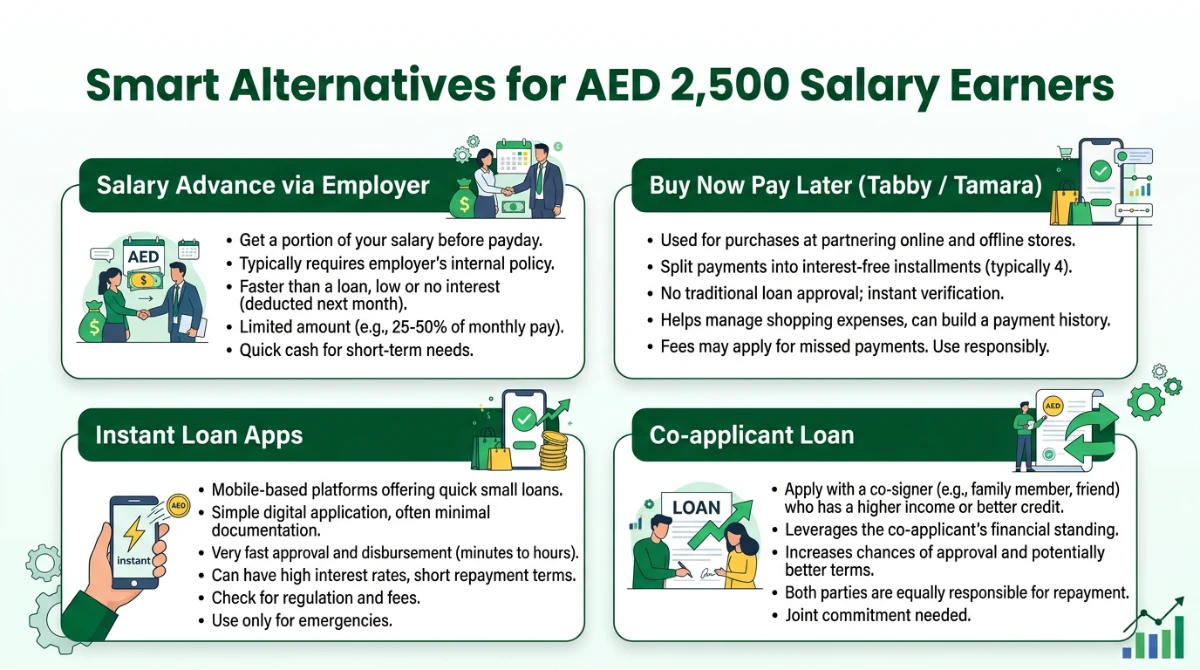
If a traditional bank loan is off the table, you still have legitimate routes. Here’s what actually works.
Salary Advance From Your Employer
Many UAE companies allow a one-time salary advance for emergencies. It’s interest-free, paid back from upcoming payroll, and doesn’t hurt your credit profile. Speak to your HR or accounts team — this is the safest first step.
Buy Now, Pay Later (BNPL) Services
Tabby and Tamara let you split purchases into 3–4 instalments without interest if paid on time. They’re ideal for one-off big buys (electronics, furniture, travel) instead of cash loans.
Licensed Instant Loan Apps
Some UAE-licensed digital lenders consider lower salaries than banks — but at higher rates. Always check licensing and read the fee print. Our curated list of top instant loan apps in the UAE is a useful starting point.
Co-Applicant or Guarantor Loan
Apply with a spouse, sibling, or trusted family member who earns above AED 5,000. Combined income improves DBR and unlocks bank-level rates that you can’t access alone.
Credit Card Cash on Eligible Salary
If you already hold a credit card from when your salary was higher, you may be able to use a small cash-on-card facility. Use carefully — interest is steep.
What If You Need Just AED 5,000–10,000?
Small-ticket needs are easier to solve than full personal loans. Some workers earning under AED 3,000 have used salary-card-linked overdraft, employer welfare funds, or small instalment apps. We’ve covered the realistic playbook in our companion post: how to get an AED 5,000 loan in the UAE on a salary below AED 3,000.
Bottom line: smaller amounts, shorter tenures and clearly licensed lenders are the safest combination at the lower end of the salary scale.
Documents Usually Asked Even at Low Salary
Even when a smaller lender considers you, the paperwork stays largely the same. Keep these ready in a single folder before applying anywhere.
| Document | Why It’s Needed |
|---|---|
| Valid Emirates ID (front & back) | Identity & residency proof |
| Passport with valid residence visa | Legal stay & KYC |
| Salary certificate or salary transfer letter | Income confirmation |
| Last 3–6 months bank statement | Cash-flow assessment |
| Latest payslip | Most recent salary proof |
| Tenancy contract / address proof | Residential verification |
How to Build Eligibility for a Future Loan
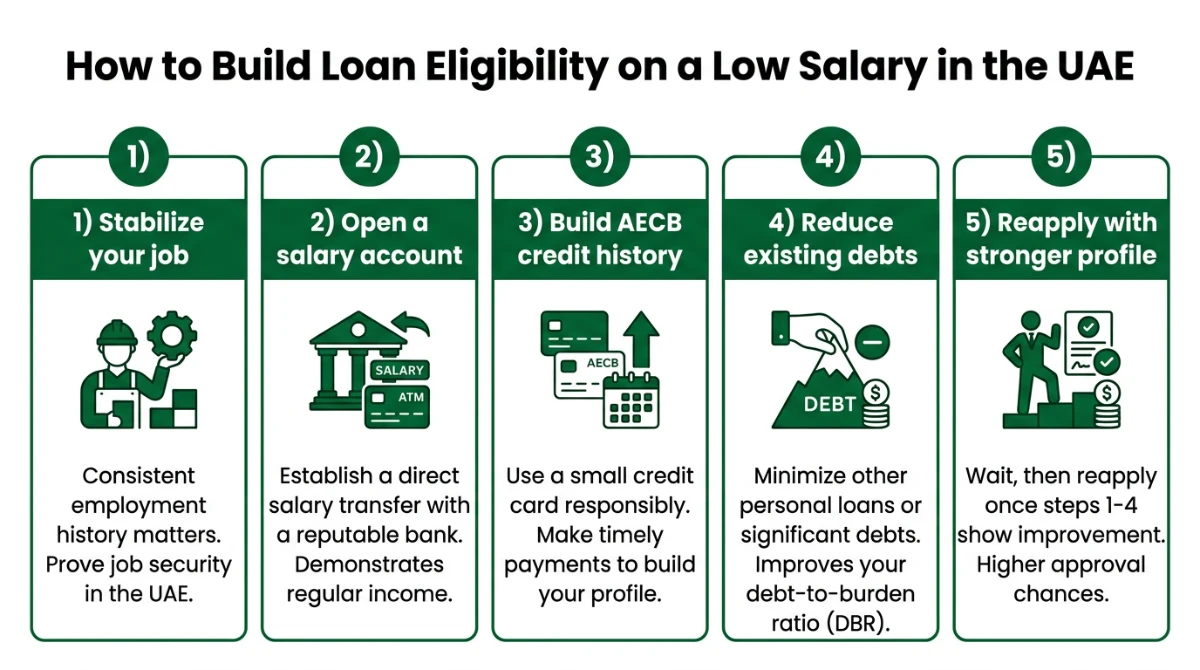
Even if today is a “no,” the next 6–12 months can flip the answer to “yes.” Here’s a realistic upgrade path.
- Stabilize your job. Banks like to see at least 3–6 months continuous employment with your current employer.
- Open a salary account. A bank that already receives your monthly credit is much more likely to lend later.
- Build AECB credit history. Use a small secured credit card and pay in full each month. Your credit score is the lever.
- Reduce existing debts. Settle small loans or credit card balances before reapplying. Lower DBR = better odds.
- Negotiate a salary review. Crossing AED 5,000 — even by a few hundred dirhams — opens the mainstream loan market.
EMI Reality Check Before You Borrow
Imagine you do qualify (perhaps via co-applicant) for AED 25,000 over 36 months at a flat rate of around 8% per year. The math doesn’t lie — and it shows why low-salary borrowers must be cautious.
| Loan Amount | Tenure | Approx Monthly EMI | Roughly % of AED 2,500 Salary |
|---|---|---|---|
| AED 10,000 | 24 months | ~AED 480 | ~19% |
| AED 15,000 | 36 months | ~AED 480 | ~19% |
| AED 25,000 | 36 months | ~AED 800 | ~32% |
| AED 40,000 | 48 months | ~AED 980 | ~39% |
EMI values are illustrative only and depend on the actual rate, processing fees and insurance. Always run the exact numbers in the lender’s official calculator before signing.
Loan Scam Red Flags to Avoid
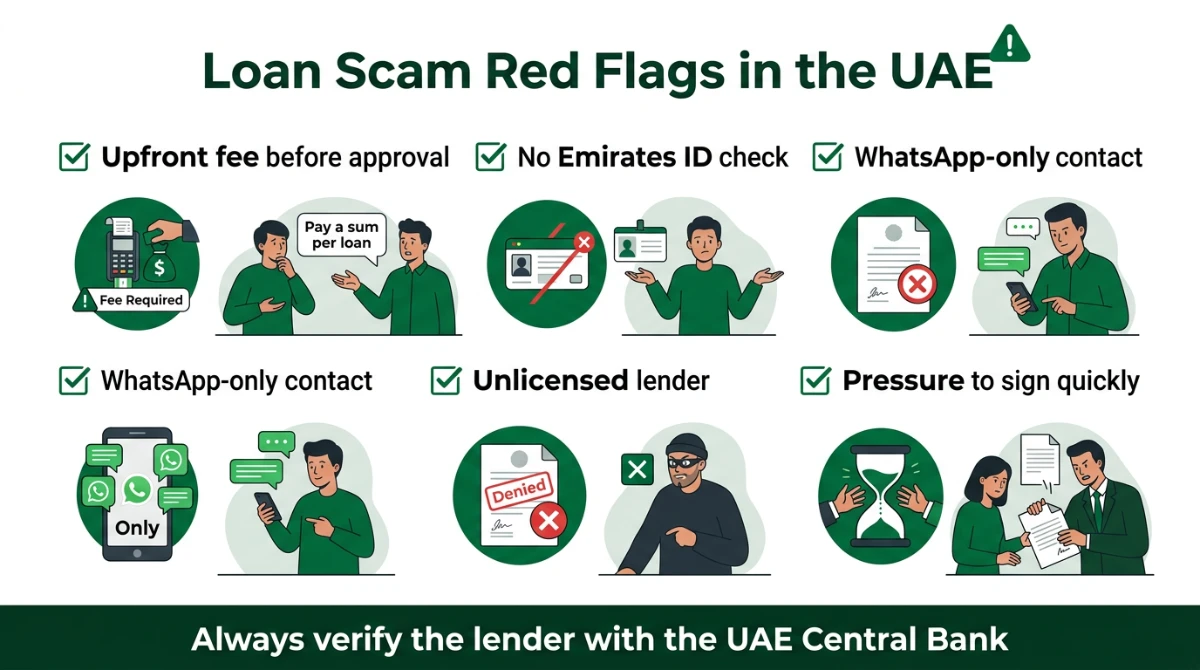
Low-salary applicants are the favourite target of UAE loan scammers. If any “lender” you find online matches the signs below, walk away.
- Asks for an upfront “processing fee,” “insurance fee,” or “file opening charge” before approval.
- Never asks for proper KYC documents or Emirates ID verification.
- Communicates only via WhatsApp or a personal mobile number.
- Has no UAE Central Bank licence or registered office address.
- Pressures you to sign or pay within minutes.
Should You Take a Loan at All on AED 2,500?
Be honest with yourself. If your monthly salary barely covers rent, food and utilities, adding an EMI of AED 400–800 will quickly push you into a debt cycle. A short-term salary advance, a BNPL split, or a family-backed co-loan is almost always healthier than a high-cost online lender.
The smartest move at this salary band is to solve the problem with the smallest possible debt, not the easiest available debt. Your future self will thank you.
Frequently Asked Questions
Can I really get a personal loan with AED 2,500 salary in UAE?
What is the minimum salary to qualify for a personal loan in the UAE?
Will a co-applicant help me get a loan on AED 2,500?
Are instant loan apps safe for low-salary workers?
Can I improve my eligibility within a few months?
What happens if I default on a UAE personal loan?
Are BNPL services like Tabby and Tamara a good substitute for a loan?
Final Takeaway
A personal loan on a flat AED 2,500 salary in the UAE is, in practical terms, not available from mainstream banks — and that’s a feature, not a bug. The eligibility rules exist to protect low-income workers from spiralling debt. Your safest path is to fix the underlying need with the smallest possible borrowing: a salary advance, a BNPL split, a co-applicant loan, or a regulated micro-loan app.
Use the next 6–12 months to upgrade your profile — stable job, salary account, AECB score, and a salary review. Once you cross the AED 5,000 mark, the entire UAE personal loan market opens up at far better rates. Until then, borrow carefully, verify every lender, and never pay an upfront fee.
Want a deeper salary-vs-loan comparison? Read our complete Dubai Personal Loan hub to compare every major scheme side-by-side.
Sources
- UAE Central Bank — Consumer Protection Regulations & DBR rules: https://www.centralbank.ae/
- Emirates NBD — Personal Loans: https://www.emiratesnbd.com/en/loans/personal-loans
- First Abu Dhabi Bank — Personal Loan: https://www.bankfab.com/en-ae/personal/loans/personal-loans
- ADCB — Personal Loans: https://www.adcb.com/en/personal/loans/
- Mashreq — Personal Loans: https://www.mashreqbank.com/uae/en/personal/loans
- Dubai Islamic Bank — Personal Finance: https://www.dib.ae/personal/finance/personal-finance
- AECB — Al Etihad Credit Bureau: https://aecb.gov.ae/
Last verified: May 2026. Loan terms, salary thresholds and interest rates may change without notice — always confirm directly with the lender before applying.
