
Buying a home in the UAE is a big step — and choosing the right mortgage partner is half the battle. If Mashreq Bank is on your shortlist, you probably want clear answers, not vague brochure-speak. How much can you borrow? How long does approval take? What's the catch on rates and fees?
Here's the deal: this guide breaks down the Mashreq home loan in plain English — eligibility, loan-to-value caps, documents, charges, and the exact steps to apply. We'll also cover the commercial mortgage variant for shops, offices and warehouses, plus what non-residents can expect. Let's get started.
Mashreq Home Loan: Why It Stands Out in UAE
Mashreq is one of the UAE's oldest private banks and has built a strong reputation for digital-first mortgage processing. The home loan suite covers salaried residents, self-employed business owners, UAE nationals and non-resident investors — all under one roof.
What makes it appealing for most buyers:
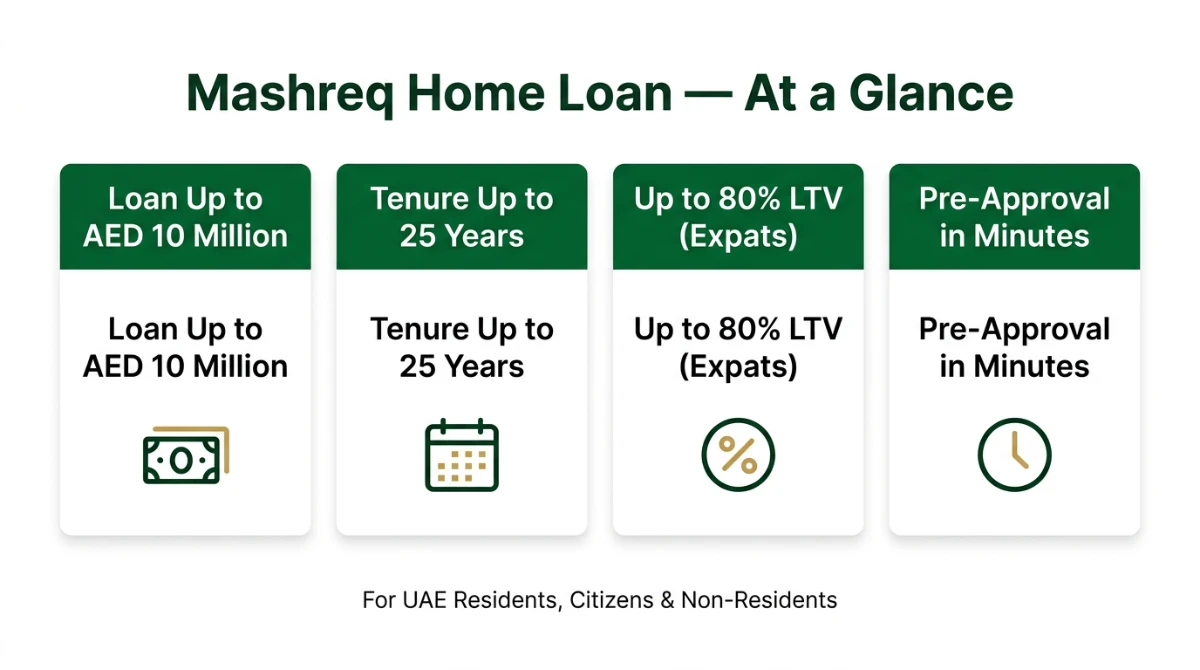
- Digital pre-approval — eligible salaried applicants can get an indicative decision online before they even pick a property.
- High loan ceiling — up to AED 10 million for qualifying borrowers and properties.
- Long tenure — up to 25 years on residential mortgages, helping keep monthly EMIs comfortable.
- Buyout & equity release — refinance an existing UAE mortgage or unlock cash from a property you already own.
- Fixed and variable rate options — choose stability or flexibility depending on your risk appetite.
For a wider view of the UAE banking ecosystem, you can also explore our complete UAE bank account opening guide, which complements the mortgage process for new residents.
Who Can Apply: Eligibility Criteria
Eligibility rules follow UAE Central Bank guidelines plus Mashreq's internal credit policy. Here's a clean snapshot of what most applicants need to meet.
| Criteria | Typical Requirement |
|---|---|
| Age | 21 years (minimum) up to 65 years for salaried / 70 years for self-employed at loan maturity |
| Residency | UAE nationals, resident expats, and selected non-residents |
| Employment | Salaried or self-employed with verifiable income |
| Minimum Income | Indicative starting point around AED 15,000 per month for salaried (varies by case) |
| Loan-to-Value (LTV) | Up to 80% (expats), up to 85% (UAE nationals), up to 60% (non-residents) on first property |
| Credit History | Clean Al Etihad Credit Bureau (AECB) record with healthy debt-burden ratio |
| Property Type | Ready or under-construction residential, plus commercial units (shops, offices, warehouses) |
Documents Required to Apply
Keeping paperwork ready upfront cuts approval time dramatically. Most home loan rejections in the UAE are not about credit — they're about incomplete documentation.
For Salaried Applicants
- Passport copy with valid UAE residence visa
- Emirates ID (front and back)
- Salary certificate addressed to Mashreq Bank (recent date)
- Last 3 to 6 months of bank statements showing salary credit
- Liability letter from your existing bank (if you have other loans)
For Self-Employed Applicants
- Valid trade license and Memorandum of Association
- Audited financials (typically last 2 years) or office tenancy contract
- Last 6 to 12 months of company and personal bank statements
- Passport, visa and Emirates ID copies of partners and shareholders
Property-Side Documents
- Memorandum of Understanding (MOU) / Form F signed with the seller
- Title deed copy
- Developer's no-objection certificate (NOC) where applicable
- Latest service charge statement for completed properties
Interest Rates, Loan Amount and Tenure
Mashreq offers both fixed-rate and variable-rate home loans, with the variable option pegged to EIBOR (Emirates Interbank Offered Rate) plus a fixed margin. Pricing is case-specific — your salary, employer category, property type and LTV all push the rate up or down.
| Feature | Indicative Range |
|---|---|
| Maximum Loan Amount | Up to AED 10 million (subject to income & property value) |
| Residential Tenure | Up to 25 years |
| Commercial Tenure | Up to 15 years |
| Rate Type | Fixed (1–5 year intro) or variable (EIBOR + margin) |
| Repayment | Monthly EMI via standing instruction or salary transfer |
Fees and Charges You Should Know
| Charge | Indicative Amount |
|---|---|
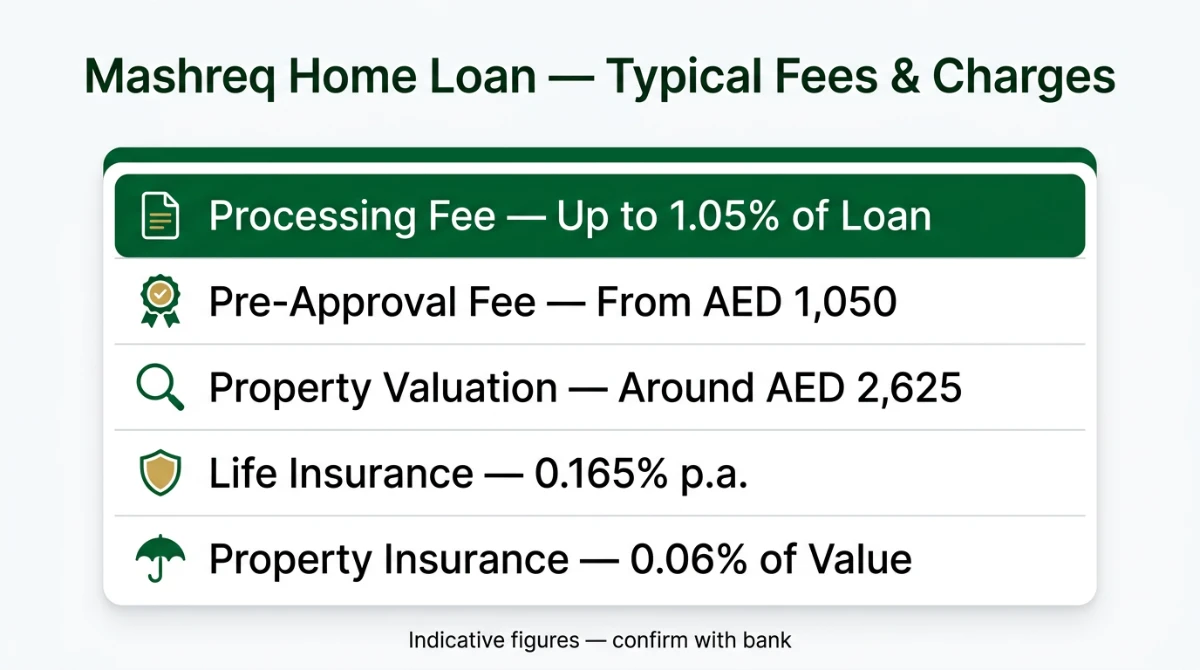
| Processing Fee | Up to 1.05% of loan amount, capped per bank tariff |
| Pre-Approval Fee | From around AED 1,050 (where applicable) |
| Property Valuation | Around AED 2,500 to AED 3,000 per property |
| Life Insurance | Approx. 0.165% per annum on outstanding balance |
| Property Insurance | Approx. 0.06% of property value annually |
| Early Settlement | Up to 1% of outstanding (capped at AED 10,000 per Central Bank rules) |
| Late Payment | As per Mashreq's published schedule of charges |
All figures above are indicative and based on Mashreq's published tariff. Always request the bank's Key Facts Statement (KFS) before signing — it lists every charge in writing for your specific loan offer.
Residential vs Commercial vs Non-Resident Home Loan
| Feature | Residential Home Loan | Commercial Mortgage | Non-Resident Home Loan |
|---|---|---|---|
| Purpose | Buy / build / renovate home | Buy or refinance shop, office, warehouse | Vacation home or investment property in UAE |
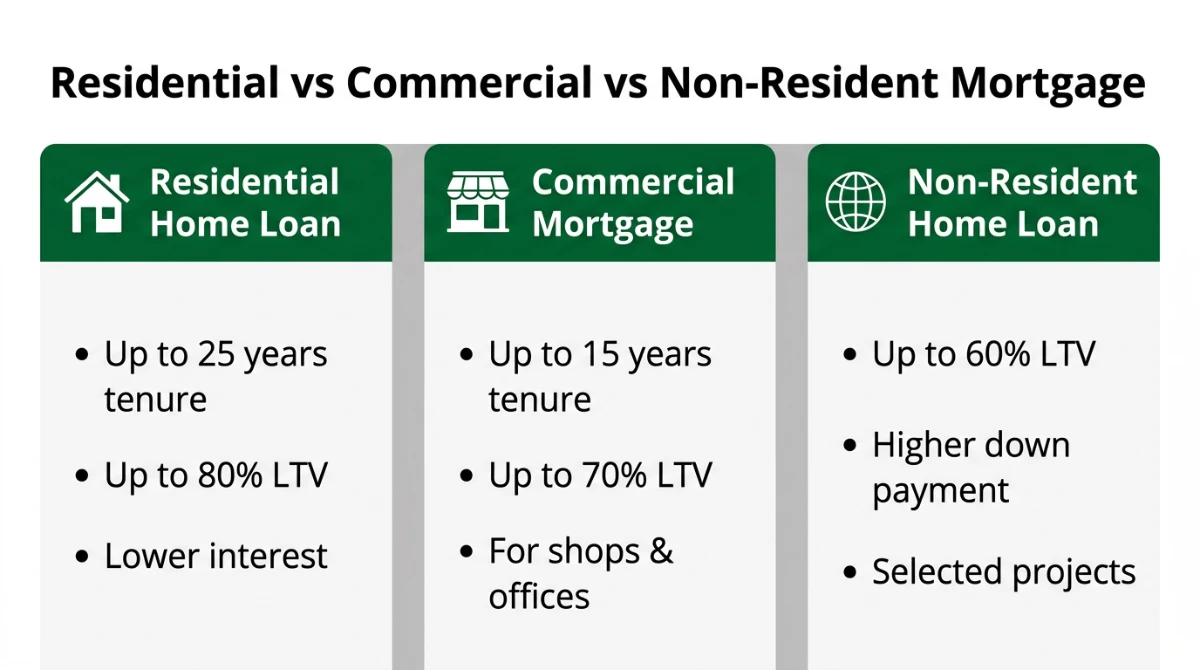
| Tenure | Up to 25 years | Up to 15 years | Around 15–20 years |
| Max LTV | Up to 80% (expat) / 85% (UAE national) | Up to ~70% of property value | Up to 60% |
| Down Payment | 15–20% (first home) | 30–40% | 40% or more |
| Interest Rate | Lowest of the three | Slightly higher than residential | Highest of the three |
| Best For | Salaried & self-employed UAE residents | Business owners expanding operations | Overseas investors entering UAE market |
How to Apply for Mashreq Home Loan: Step by Step
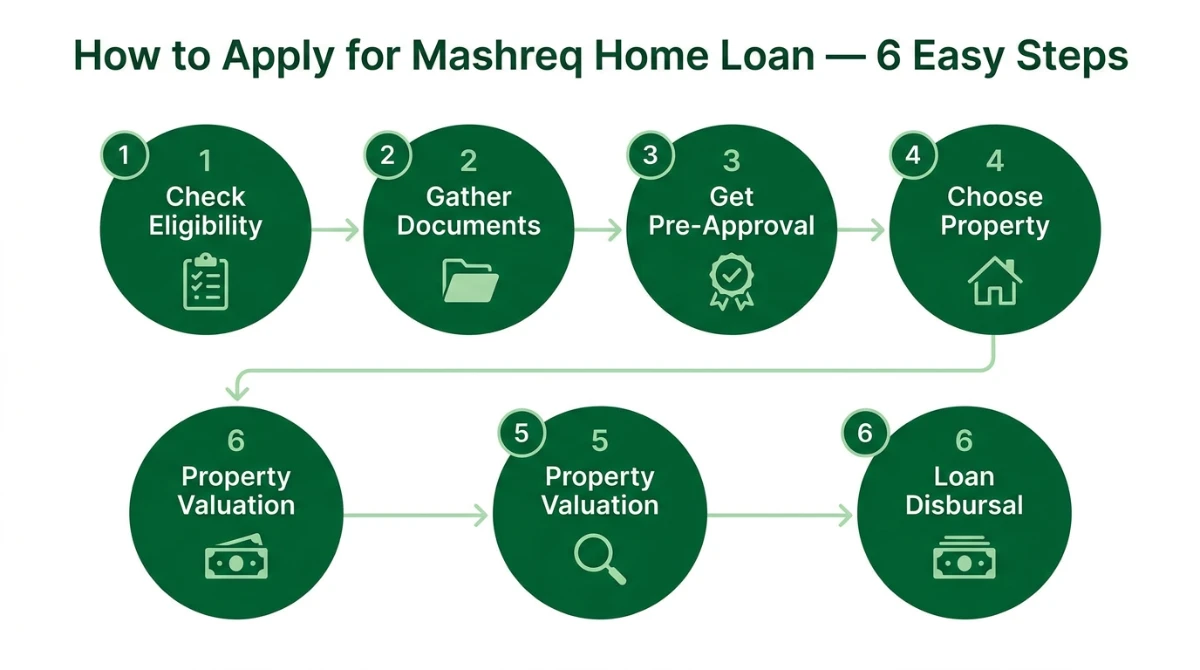
The smart move is to get pre-approved before you sign any property MOU. That way you know your real budget and you negotiate from strength.
- Check eligibility online. Use Mashreq's website or NEO app to run a quick affordability check based on your income and existing liabilities.
- Gather your documents. Prepare the salaried or self-employed document set listed above and scan everything in clear PDFs.
- Apply for pre-approval. Submit a digital application or visit a branch. Salaried applicants often get an indicative decision within minutes.
- Shortlist your property. Once pre-approved, you have around 60 to 90 days to finalise a property within your sanctioned limit.
- Property valuation & final approval. Mashreq's panel valuer assesses the property; the bank then issues the final offer letter and KFS.
- Sign mortgage and disbursal. Sign loan documents, register the mortgage with the relevant Land Department, and the bank releases funds to the seller.
If you're still building your borrowing profile, you may want to start with a Mashreq personal loan for new customers to establish a clean repayment record before applying for a larger mortgage.
Smart Tips Before You Sign
- Compare at least 3 banks. Even a 0.5% difference in rate compounds into tens of thousands of dirhams over 25 years.
- Read the KFS line by line. Look for fees on swap (rate switch), partial settlement, top-up and early settlement.
- Check the EIBOR reset frequency. Variable loans usually reset every 1, 3 or 6 months — that affects EMI volatility.
- Insurance is mandatory. Property insurance and life cover are required; you can sometimes assign an existing policy instead of buying the bank's.
- Don't max out your DBR. Leave headroom for emergencies; UAE Central Bank caps DBR at 50% of monthly income for a reason.
Frequently Asked Questions
Can expats apply for a Mashreq Bank home loan in the UAE?
What is the maximum home loan amount and tenure?
How much down payment do I need for a Mashreq home loan?
Which documents are required to apply?
How long does Mashreq take to approve a home loan?
Can I refinance my existing mortgage with Mashreq Bank?
Are there processing fees and early-settlement charges?
Is salary transfer mandatory for a Mashreq home loan?
Final Takeaway
The Mashreq home loan is a solid pick for UAE buyers who value digital speed, flexible tenure and a high loan ceiling. Residents, citizens and even non-resident investors have a clear path to ownership — provided the income, credit profile and property paperwork stack up.
Bottom line: don't shop on rate alone. Look at the full package — fees, fixed-rate window, EIBOR reset rules and early-settlement clauses. Get a Key Facts Statement in writing, compare it against at least one or two competing banks, and only then sign on the dotted line.
If this guide helped you, share it with a friend who's house-hunting in the UAE — and drop your questions in the comments so we can keep this resource sharp.
Sources
- Mashreq Bank — Home Loans for UAE Residents: https://www.mashreq.com/en/uae/neo/loans/mortage-loans/mashreq-home-loans/
- Mashreq Bank — Home Loan for Non-Residents: https://www.mashreq.com/en/uae/private/banking-solution/home-loans/home-loan-non-residents/
- Mashreq Bank — Mortgage Loans Overview: https://www.mashreq.com/en/uae/neo/loans/mortage-loans/
- Mashreq Bank — Real Estate Financing (Private Banking): https://www.mashreq.com/en/uae/private/banking-solution/loans/real-estate-financing/
- Mashreq Bank — Mortgage-backed Financing for SME (Key Fact Statement, PDF): https://www.mashreq.com/-/jssmedia/pdfs/business/KFS-TnC/mortgage-backed-financing-sme-en.ashx
- UAE Central Bank — Mortgage Regulations & DBR guidelines: https://www.centralbank.ae/
- Al Etihad Credit Bureau — Credit Reports: https://aecb.gov.ae/
Last verified: May 2026. Rates, fees and eligibility may change — always confirm with Mashreq Bank before applying.
