
Living in the UAE on a modest salary and wondering if a bank will actually approve you for a personal loan? You are not alone. Thousands of expats with monthly pay between AED 2,000 and AED 5,000 search for the same answer every week — and most blogs hand them recycled numbers without explaining the real eligibility rules.
Here's the deal: your salary is only one part of the puzzle. Banks also look at your employer category (listed vs non-listed), your existing debt, salary transfer, length of service, and credit score. This guide breaks all of that down in plain English so you can match your salary to the right bank — and avoid wasted applications that hurt your AECB credit score.
Let's get into it.
Quick Answer
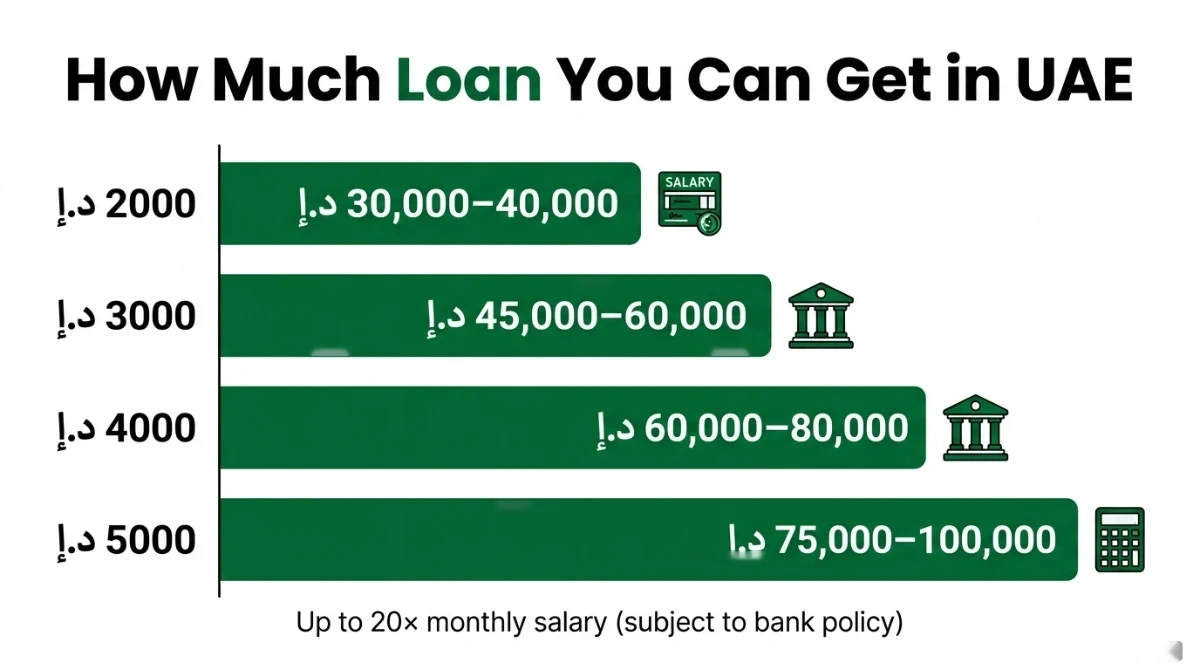
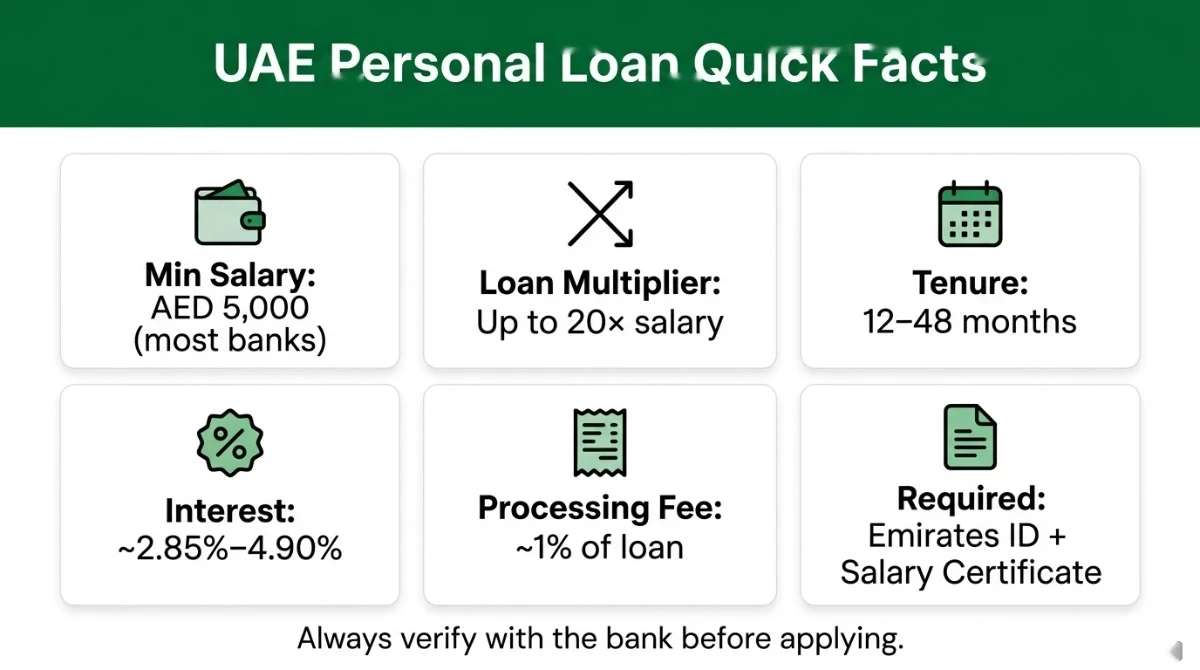
Most UAE banks require a minimum salary of AED 5,000 to approve a standard personal loan, and they typically lend up to 20× your monthly salary. So an AED 5,000 earner can usually borrow up to AED 100,000, while AED 3,000–4,000 earners often get smaller offers from select banks like RAKBANK and Dubai Islamic Bank. Below AED 3,000, options shift toward exchange-house finance and small instant loan apps.
How Banks Decide Your Personal Loan in the UAE
Before any bank prints a number on your offer letter, three things happen behind the scenes: an income check, an obligation check, and a profile check. The Central Bank of the UAE caps your total monthly debt repayments at 50% of your gross income — that's the famous DBR rule.
That single rule is why two people with the same AED 5,000 salary can get very different offers. If you already have a credit card balance or a car loan, your DBR is already eating into that 50%, leaving less room for a fresh personal loan.
Listed vs Non-Listed Company — Why It Matters
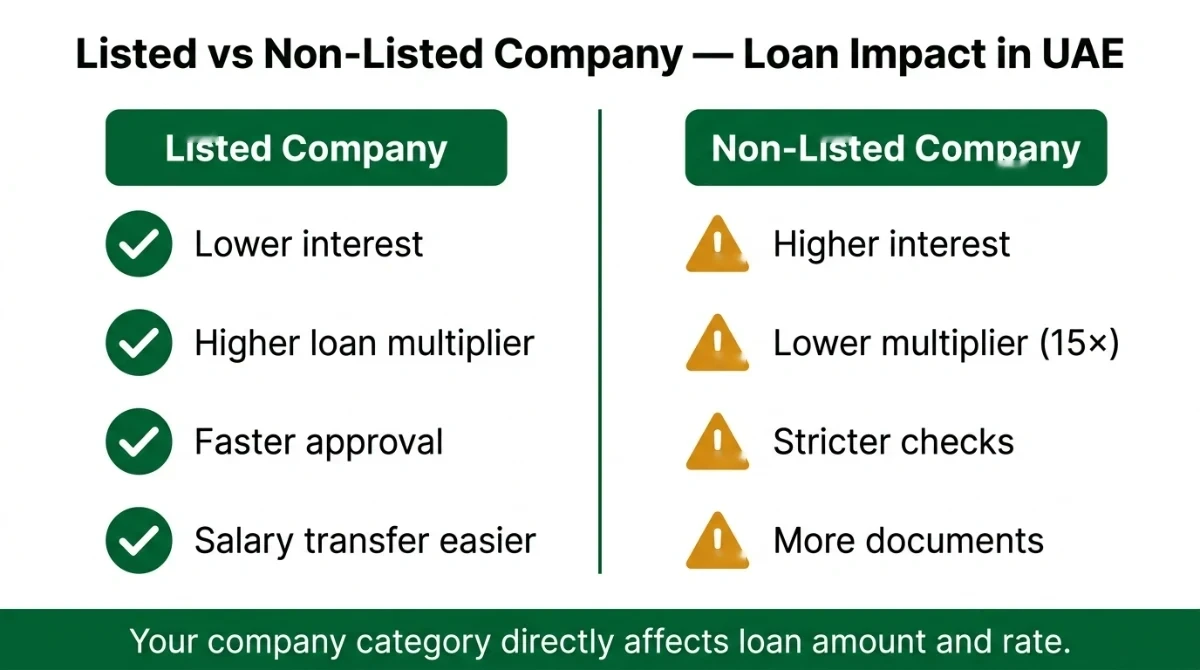
Banks maintain an internal list of approved employers, usually large, well-known organizations with stable payroll. If your company is on that list, you unlock better rates and higher multipliers. If it isn't, you can still borrow — but expect smaller amounts, more documents, and tighter pricing.
Personal Loan in UAE for AED 2,000 Salary
The honest truth: at AED 2,000 a month, mainstream banks will almost always say no to a regular personal loan. Their minimum salary cut-off sits at AED 5,000. But you still have options.
Realistic paths at this salary level include:
- Small-ticket finance from licensed exchange houses tied to your salary card.
- Buy-Now-Pay-Later facilities for specific purchases.
- Regulated instant loan apps with smaller credit lines.
If you fall in this bracket, read this practical walkthrough first: how to get a small AED 5,000 loan when your salary is below AED 3,000.
Personal Loan in UAE for AED 3,000 and AED 3,500 Salary
At AED 3,000–3,500, you're on the edge of bank eligibility. A handful of banks and finance companies will consider you, but the loan amount stays modest and the interest rate sits at the higher end of the range.
The practical upper limit is roughly 20× your salary — so theoretically AED 60,000 to AED 70,000 — but real approvals are usually 30–50% lower because of the DBR cap and the salary-cushion banks keep.
Personal Loan in UAE for AED 4,000 Salary
At AED 4,000, options open up. Several mainstream banks accept this salary level — especially if your employer is listed and your salary is transferred.
Indicative borrowing range: AED 60,000 to AED 80,000, with tenors of up to 48 months. That's roughly 15–20× your monthly pay, depending on the bank.
Documents you'll be asked for stay the same across most lenders: Emirates ID, passport with visa page, salary certificate, and the last 3–6 months of bank statements showing your salary credit.
Personal Loan in UAE for AED 5,000 Salary
This is the sweet spot. AED 5,000 unlocks the broadest list of banks — Emirates NBD, ADCB, Mashreq, RAKBANK, Emirates Islamic and many more. You'll see the most competitive rates here too.
Bottom line: at AED 5,000 monthly salary, you can typically borrow up to AED 100,000 over 4 years if you have a clean credit history and a salary-transfer account.
Working in a non-listed company on AED 5,000? You can still qualify, but expect a 15× multiplier instead of 20× and a slightly higher rate. To explore specific bank programs, see our breakdowns of the FAB personal loan in UAE and the top 20 instant loan apps in the UAE for app-based options.
Salary vs Maximum Loan — Quick Reference Table
Use the table below as a starting point. Actual approvals depend on bank policy, your employer category, and your AECB credit profile.
| Monthly Salary (AED) | Listed Company — Max Loan | Non-Listed Company — Max Loan | Typical Tenor |
|---|---|---|---|
| 2,000 | Limited / case-by-case | Usually not eligible | 12–24 months |
| 2,500 | Up to ~50,000 | Up to ~37,500 | 12–36 months |
| 3,000 | Up to ~60,000 | Up to ~45,000 | 24–48 months |
| 3,500 | Up to ~70,000 | Up to ~52,500 | 24–48 months |
| 4,000 | Up to ~80,000 | Up to ~60,000 | 36–48 months |
| 4,500 | Up to ~90,000 | Up to ~67,500 | 36–48 months |
| 5,000 | Up to ~100,000 | Up to ~75,000 | 36–48 months |
UAE Banks That Lend Against Lower Salaries
Not every bank starts at the same minimum salary. Below is an indicative list. Always confirm the latest cut-off with the bank before applying — products change frequently.
| Bank / Lender | Indicative Minimum Salary | Typical Loan Multiplier | Notes |
|---|---|---|---|
| RAKBANK | From ~AED 5,000 | Up to 20× | Salary transfer preferred |
| Emirates NBD | From ~AED 5,000 | Up to 20× | Wide listed-company list |
| ADCB | From ~AED 5,000 | Up to 20× | Stronger for listed firms |
| Mashreq | From ~AED 5,000 | Up to 20× | Digital application via app |
| Emirates Islamic | From ~AED 6,000 | Up to 20× | Sharia-compliant finance |
| FAB | From ~AED 7,000 | Up to 20× | Premium pricing for top employers |
| Dubai Islamic Bank | From ~AED 7,000 | Varies | Islamic personal finance |
Documents You Need Before Applying
Banks want to verify three things: who you are, where you live, and how stable your income is. Get these ready and your application moves faster.
- Original Emirates ID (front and back).
- Passport with valid UAE residence visa.
- Salary certificate or salary transfer letter (recent, addressed to the bank).
- Last 3–6 months of bank statements showing salary credits.
- Latest payslip if your HR can issue one.
- Trade licence and recent statements if self-employed.
How to Apply for a UAE Personal Loan — Step by Step
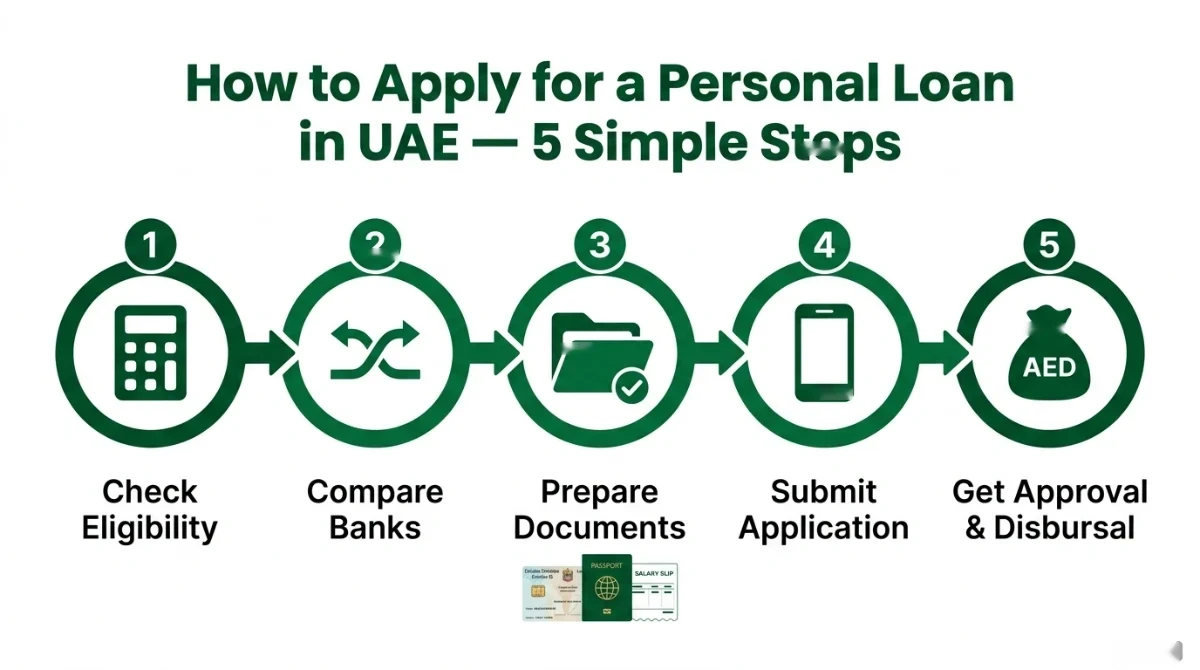
- Check your eligibility: match your salary, employer status, and DBR against the bank's stated minimums.
- Compare offers from at least three banks: look at the flat rate, the reducing rate, processing fee, and early-settlement fee — not just the EMI.
- Prepare documents: Emirates ID, passport, salary certificate, and bank statements.
- Submit your application: through the bank's app, website, or branch. Many banks now offer fully digital approvals.
- Sign and receive disbursal: after the offer letter, sign the agreement and the funds are credited to your account, usually within 1–3 working days.
Interest Rates, Fees, and the True Cost of Borrowing
The advertised "from" rate is rarely the rate you get. Banks use risk-based pricing, so your real APR depends on your salary, employer, tenor, and credit history.
| Cost Item | What to Expect | Why It Matters |
|---|---|---|
| Flat interest rate | Roughly 2.85%–4.90% p.a. (indicative) | Headline number — but reducing rate is the real measure |
| Processing fee | ~1% of the loan amount (cap may apply) | Deducted upfront; reduces net disbursal |
| Insurance / life cover | Mandatory in many cases | Adds to total cost; check if it's already in EMI |
| Early settlement fee | ~1% of outstanding (cap may apply) | Important if you plan to prepay |
| Late payment fee | Varies by bank | Avoid by keeping a buffer in your salary account |
Common Mistakes That Get Applications Rejected
Most rejections aren't about salary — they're about avoidable mistakes. Watch out for these:
- Inconsistent salary: bonuses or variable pay confuse underwriting models.
- High DBR: existing cards and EMIs already eating your 50% limit.
- Recent rejections: back-to-back applications across banks signal stress.
- Bounced cheques or late payments: visible to every UAE bank via AECB.
- Wrong employer status: applying to a bank where your company isn't approved.
Missing an EMI is even costlier later. If you're worried about repayment risk, read this deep dive on what really happens if you miss a loan EMI in the UAE.
Smart Tips to Maximize Your Loan Offer
- Park your salary first: 3–6 months of clean salary credits beats every other trick.
- Pay down credit cards before applying: reducing utilization frees up DBR room.
- Pick a slightly longer tenor: lower EMI improves DBR math and approval odds.
- Negotiate the rate: if you have multiple offers, banks often match or beat.
- Ask about top-ups later: a clean repayment record opens doors to a top-up loan after 6–12 months.
Frequently Asked Questions
What is the minimum salary to get a personal loan in the UAE?
For most mainstream UAE banks, the minimum salary is AED 5,000 per month with a salary-transfer account. A few finance companies and selected programs accept lower salaries on a case-by-case basis, but the loan amount and tenor are usually smaller. Always confirm the current minimum directly with the bank, as policies can change without prior notice.
How much loan can I get on an AED 3,000 salary in the UAE?
On paper, the 20× rule allows up to roughly AED 60,000. In practice, very few banks lend at this salary level, and approved amounts are usually lower because of the 50% DBR cap and conservative scoring. Salary transfer, listed-company employment, and a clean AECB record dramatically improve your chances.
Is salary transfer compulsory for a UAE personal loan?
It is not legally compulsory, but it heavily influences pricing and limits. Salary-transfer customers usually get higher loan multipliers, lower rates, and faster approvals. Non-salary-transfer loans do exist, however they are typically capped at lower amounts and priced higher to offset the bank's risk.
Can I get a personal loan if I work for a non-listed company?
Yes, but the conditions are tighter. Expect a 15× multiplier instead of 20×, slightly higher interest rates, and additional documentation. Some banks may require a guarantor or a longer minimum service period with the same employer. Compare offers from at least three lenders before deciding.
What is the typical interest rate on UAE personal loans?
Headline flat rates fall roughly between 2.85% and 4.90% per year, depending on the bank, your salary, employer, and tenor. Always look at the reducing rate equivalent and the full APR including processing and insurance fees, since the advertised flat rate alone never tells the complete story.
How long does UAE personal loan approval usually take?
Digital applications from existing salary-transfer customers can be approved within hours and disbursed the same or next day. Fresh applications with full document submission typically clear within 1–3 working days, while complex profiles, non-listed employers, or self-employed applicants may take up to a week.
Will applying to multiple banks hurt my credit score?
Yes. Each formal application creates an enquiry on your AECB report. Several enquiries inside a short window are read as financial stress and can lower your score, leading to automatic rejections from other banks. Compare offers first, then apply only to the bank most likely to approve you.
Can I prepay or settle my personal loan early?
Yes. UAE banks allow early settlement, but most charge a fee — commonly around 1% of the outstanding principal, subject to regulatory caps. Before signing, ask for the exact early-settlement clause in writing and run the numbers. Sometimes a partial prepayment makes more sense than a full settlement.
Final Takeaway
Your UAE personal loan size isn't just about how much you earn — it's about how clean your financial picture looks to a bank. AED 5,000 with salary transfer and a tidy AECB record will outperform AED 6,000 with cluttered debts every single time.
If your salary sits between AED 2,000 and AED 5,000, the smartest play is to clean up first, compare three lenders, then apply once. Don't shotgun applications across the market — that strategy backfires inside the AECB system.
Need help picking the right bank? Drop your salary range and employer type in the comments and we'll point you to the most realistic options. We reply within 2 hours.
Sources
- Central Bank of the UAE — Consumer Protection Regulations and Standards: https://www.centralbank.ae
- Al Etihad Credit Bureau (AECB) — Credit Report and Score guidance: https://www.aecb.gov.ae
- Emirates NBD — Personal Loan product page: https://www.emiratesnbd.com
- Abu Dhabi Commercial Bank (ADCB) — Personal Loan product page: https://www.adcb.com
- Mashreq Bank — Personal Loan product page: https://www.mashreqbank.com
- RAKBANK — Personal Loan product page: https://www.rakbank.ae
- First Abu Dhabi Bank (FAB) — Personal Loan product page: https://www.bankfab.com
Last verified: May 2026. Bank policies, minimum salaries, and rates change frequently — confirm current terms directly with the lender before applying.
