
Earning around AED 2,000 a month in the UAE and trying to get a personal loan? You are not alone — and you have probably already noticed that most ads promise the moon, but the bank counter says something very different. Here is the deal: most UAE banks set their minimum salary at AED 5,000, so a straight personal loan on a 2,000 paycheck is almost never approved. The good news? There are still smart, legal, and safer routes you can use today. This guide breaks down what is realistic, what to avoid, and how to build a path that actually works.
Quick Answer
Can you get a regular UAE bank personal loan on AED 2,000 salary? No — almost all UAE banks require a minimum salary of AED 5,000 (some go up to AED 10,000). With AED 2,000, your realistic options are: an employer salary advance, a licensed earned-wage app (like FlexxPay), a joint or co-applicant loan, or building your salary and credit profile first.
Why AED 2,000 Salary Is Below the UAE Loan Threshold
UAE banks price every loan against repayment risk. The lower the salary, the smaller the surplus left after rent, food, transport, and remittances — which is why regulators and risk teams set a salary floor. Here is the honest picture:
- The Central Bank of the UAE caps total monthly EMI at 50% of your salary.
- Most banks demand a minimum AED 5,000 salary, salary-transferred to a UAE account.
- A 50% cap on AED 2,000 leaves only AED 1,000 for EMI — too small for a meaningful loan tenure and interest profile.
- Banks also require a clean AI Bureau (Al Etihad Credit Bureau) score, which you cannot build without prior credit activity.
What UAE Banks Actually Require (Eligibility Truth)
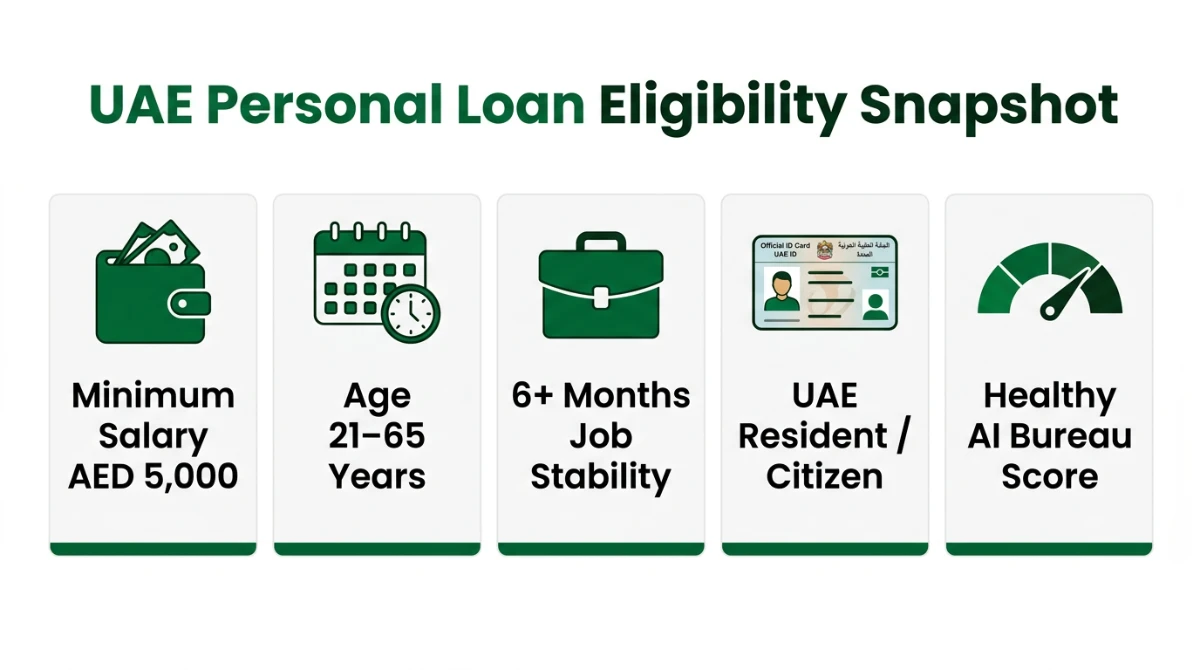
Before you even discuss amount or tenure, banks check five basics. Miss one, and the application is rejected before underwriting even begins.
| Check | Standard Requirement | Why It Matters |
|---|---|---|
| Minimum salary | AED 5,000+ (most banks) | Ensures repayment after living costs |
| Age | 21 to 60–65 years | Working-life cap aligns with tenure |
| Job stability | 3–6 months minimum with current employer | Reduces income discontinuity risk |
| Residency | UAE resident or citizen | Legal recoverability of the loan |
| Credit score | Healthy AI Bureau report (no defaults) | Predicts repayment behaviour |
If your salary is AED 2,000, you typically fail check #1 right away. That does not mean you are stuck — it means you should switch from “bank personal loan” to smarter eligibility-friendly routes tailored to your real income.
UAE Bank Minimum Salary Comparison
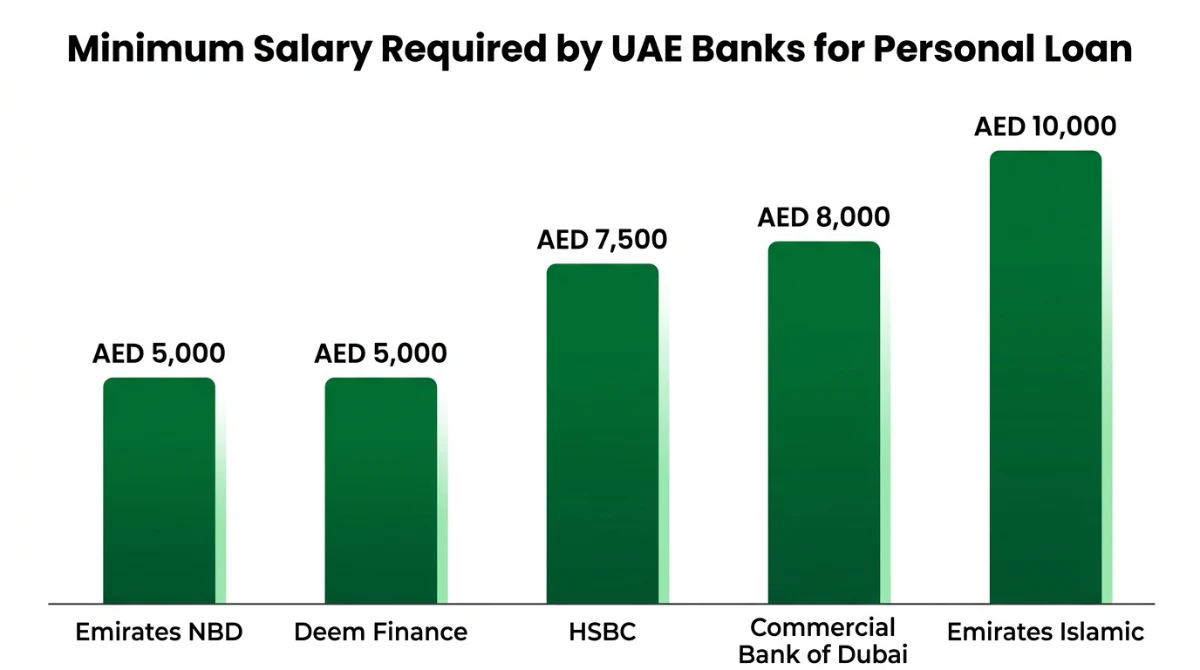
Here is how leading UAE lenders stack up on the salary floor. None of them go below AED 5,000 for a standard personal loan — and that is the single most important fact for anyone earning AED 2,000.
| Lender | Minimum Salary | Indicative Loan Cap | Typical Tenure |
|---|---|---|---|
| Emirates NBD | AED 5,000 | Up to AED 3 million | Up to 48 months |
| Deem Finance | AED 5,000 | Up to AED 500,000 | 1–4 years |
| HSBC UAE | AED 7,500 | Up to AED 500,000 | 12–60 months |
| Commercial Bank of Dubai | AED 8,000 | Up to AED 150,000 | 12–48 months |
| Emirates Islamic | AED 10,000 | Up to AED 500,000 | 12–60 months |
Smart Alternatives for AED 2,000 Earners
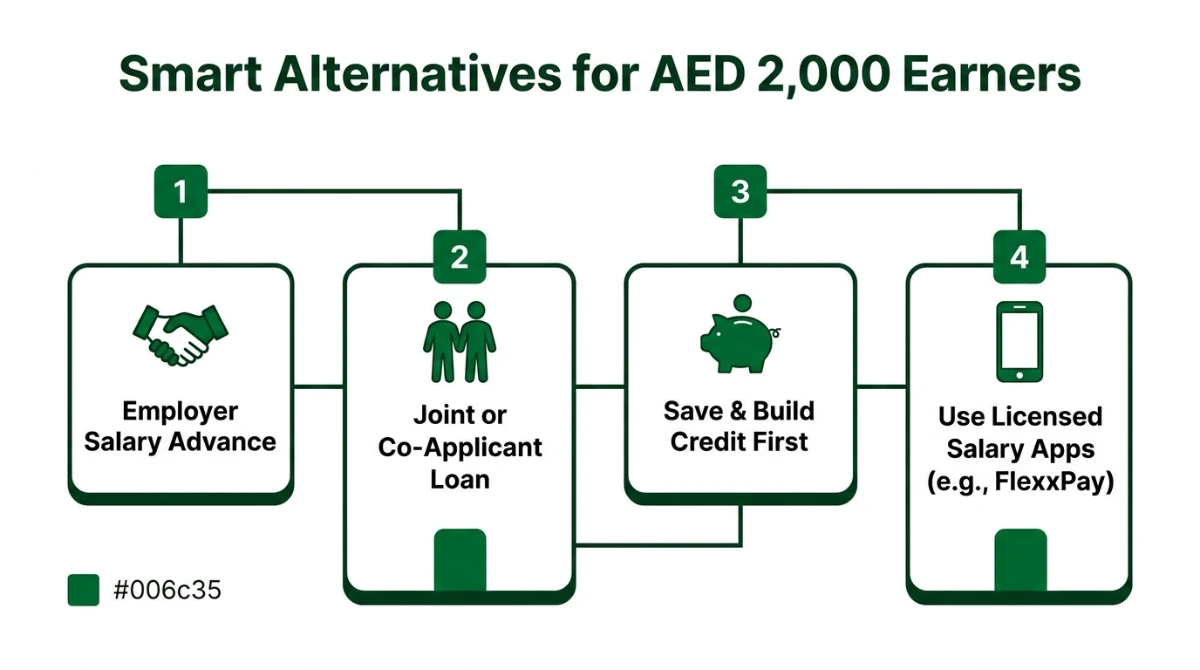
If a regular bank personal loan is closed, a few realistic doors are still open. Each one trades a different thing — speed, cost, or paperwork — for accessibility.
1. Employer Salary Advance
Many UAE companies — especially construction, hospitality and logistics employers — offer an internal salary advance equal to 1 month of pay, repaid by deduction over the next 1–3 months. Cost: usually zero. Talk to HR before looking outside.
2. Licensed Earned-Wage Apps (FlexxPay, etc.)
Some Dubai-based platforms partner with employers to let you withdraw a portion of your already earned salary before payday. Make sure the app is integrated through your employer and that fees are transparent. Avoid any “loan app” that asks for huge processing fees upfront.
3. Joint or Co-Applicant Loan
If your spouse, sibling or parent meets the AED 5,000+ salary rule, banks may consider a joint application. The co-applicant becomes legally liable, so this is a serious step — but it can unlock a small personal loan you could not get alone.
4. Save First, Build Credit, Then Borrow
Open a free or low-balance UAE bank account, route your salary through it, take a small secured credit card if eligible, and pay every bill on time. After 6–12 months you will have an AI Bureau footprint, and your odds of qualifying for a real loan when your salary improves go up sharply.
What to Avoid When You Have a Low Salary
Low-salary borrowers are the favourite target of fraudsters and unregulated lenders. Watch out for these warning signs:
- Upfront fee scams: A “bank officer” asking for AED 500–1,500 to “process” your file before any approval.
- Fake portals: Websites that mimic Emirates NBD, FAB or HSBC pages and ask for OTP or Emirates ID photos.
- WhatsApp loan offers: Anyone offering AED 50,000 instantly with “only Emirates ID” is selling a problem, not a solution.
- Cheque-discounting agents: They give cash now against post-dated cheques — and use bounced-cheque law against you later.
Documents You Will Need (When You Become Eligible)
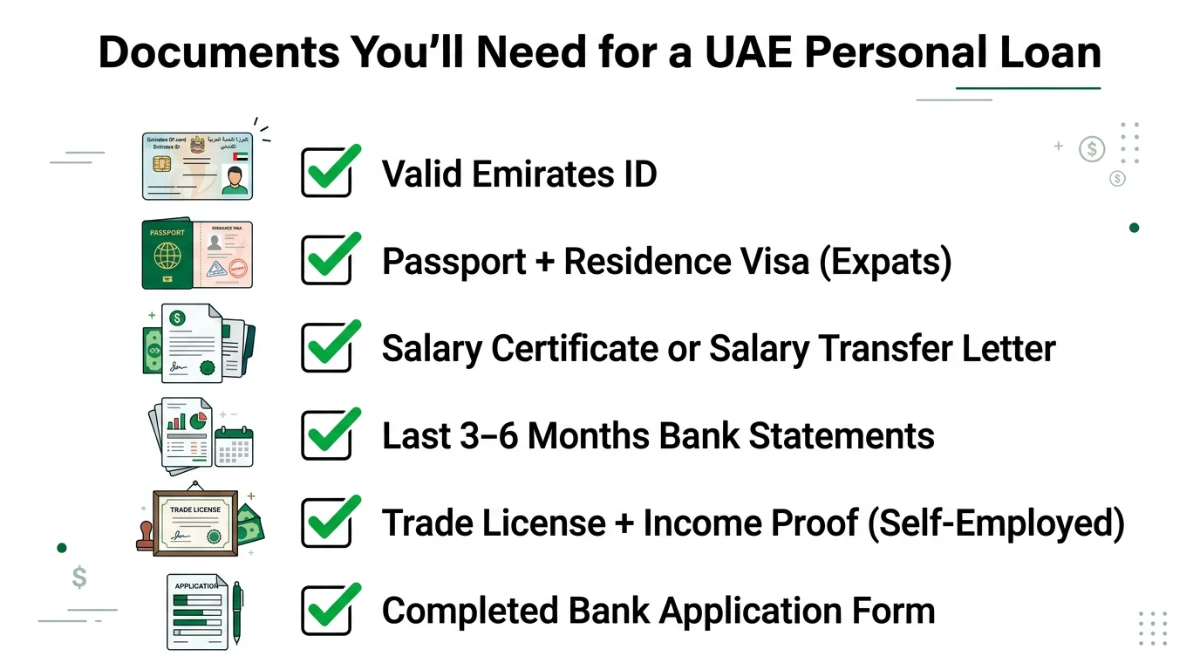
Once your salary crosses the eligibility line, the paperwork itself is straightforward. Keep digital copies ready in advance to speed up the process.
| Document | Who Needs It | Purpose |
|---|---|---|
| Valid Emirates ID | All applicants | Identity verification |
| Passport + Residence Visa | Expatriates | Residency proof |
| Salary certificate / salary transfer letter | Salaried employees | Income confirmation |
| Last 3–6 months bank statements | All applicants | Cash-flow check |
| Trade license + income proof | Self-employed | Business income proof |
| Completed application form | All applicants | Formal request |
Step-by-Step Path From AED 2,000 to a Real Loan
Treat this as a 3–6 month plan rather than a one-day application. Each step lifts you closer to bank-grade eligibility.
- Audit your salary contract. If you are below AED 2,500, ask HR if any portion is paid as allowance vs basic — sometimes the WPS-recorded salary is higher than you think.
- Open a UAE bank account that accepts low salaries. Several digital and salary accounts allow zero balance. Make sure your salary is transferred into it via WPS.
- Skip predatory apps, and instead consider licensed UAE instant loan apps only when they clearly disclose fees and partner with regulated lenders.
- Build a 3–6 month transaction history. Pay your phone bill, DEWA and rent on time — every entry helps your credit footprint.
- Aim for an AED 3,000+ jump. A small overtime, language allowance or role upgrade is often enough. Once you cross AED 3,000, options like the small AED 5,000 loan route for sub-3,000 salary become realistic.
- Compare offers. When eligible, compare 2–3 lenders on flat rate, reducing rate, processing fee, life insurance and early settlement charges — never just on EMI size.
If Your Salary Is Closer to AED 2,500
You sit in a slightly better grey zone. Some finance companies and select employer-tied schemes start considering files at AED 2,500–2,999, especially if you have salary transfer plus a stable employer. A focused read of our dedicated guide on personal loans for AED 2,500 salary will save you weeks of trial and error.
Frequently Asked Questions
Can I really get a UAE personal loan with an AED 2,000 salary?
Realistically, no. Mainstream UAE banks set their minimum salary at AED 5,000 and most premium banks ask for AED 7,500–10,000. With AED 2,000, the Central Bank’s 50% EMI cap leaves you only AED 1,000 of borrowing capacity per month, which does not justify a standard personal loan. Your better path is a salary advance, joint application, or boosting your income first.
Are there any banks or finance companies offering loans below AED 5,000 salary?
For a regular bank personal loan, almost none. A few non-bank finance companies and employer-tied schemes occasionally consider AED 3,000–4,000 salaried staff working with their listed companies. Anyone advertising a “guaranteed loan on AED 2,000 salary” without checking employer, credit and WPS history is very likely unsafe.
Are AED 2,000-salary loan ads on social media real?
Most are not. They are often lead-collection traps run by unlicensed agents who later charge a “processing fee” and either vanish or push you into expensive informal credit. Always verify the lender on the Central Bank of the UAE’s licensed list and never share your Emirates ID, OTP or bank password through chat.
Can I take a loan jointly with my spouse to qualify?
Yes, several UAE banks allow joint personal loan applications if at least one applicant meets the salary and credit requirements. The higher-earning applicant typically becomes the primary borrower. Both partners are legally liable, so treat it like a serious commitment, not a shortcut.
Will applying and getting rejected hurt my credit score?
Each formal application creates a credit enquiry on your AI Bureau report. A handful of enquiries usually has minimal impact, but multiple rejections within a short window can flag you as a risky applicant. The smarter route is to confirm eligibility informally, then apply with one or two lenders only.
What is the safest first step if I currently earn AED 2,000?
Open a salary-friendly UAE bank account, get your employer to register you under WPS, ask HR about an internal salary advance or earned-wage app, and start building 3–6 months of clean banking history. Once your salary moves toward AED 3,000–5,000, mainstream loan options open up far faster than you expect.
Are instant loan apps a good substitute for a bank loan?
They can be — but only the licensed, employer-integrated ones. Apps that ask for Emirates ID photos, friend contacts, or upfront fees should be avoided. Use established review lists like the top instant loan apps in UAE as a starting reference, and always read the fee schedule before borrowing.
Conclusion
The honest truth: a regular UAE personal loan on an AED 2,000 salary is almost never approved, and chasing it through unlicensed channels usually costs more than the loan itself. The smarter move is a 3–6 month plan — open a salary account, ask HR for an advance, use a regulated earned-wage app if available, consider a joint application, and aim to lift your salary or basic component above AED 3,000–5,000. Once you do, mainstream banks become an open door instead of a closed counter. Keep your documents clean, your AI Bureau record healthy, and never share OTPs, Emirates ID images or signed cheques with anyone outside a licensed bank or finance company.
Next step: bookmark this guide, run your numbers through the eligibility calculator, and come back to compare bank options the moment your salary crosses the AED 5,000 mark.
Sources
- Central Bank of the UAE — Consumer Protection Regulation & Standards: https://www.centralbank.ae
- Al Etihad Credit Bureau — Credit Report & Score: https://www.aecb.gov.ae
- Emirates NBD — Personal Loan: https://www.emiratesnbd.com
- HSBC UAE — Personal Loan: https://www.hsbc.ae
- Commercial Bank of Dubai — Personal Loans: https://www.cbd.ae
- Emirates Islamic — Personal Finance: https://www.emiratesislamic.ae
- Deem Finance — Personal Loan: https://www.deem.io
- UAE Ministry of Human Resources & Emiratisation (Wage Protection System / WPS): https://www.mohre.gov.ae
Last verified: May 2026. Lender criteria, salary thresholds, fees and tenures change frequently — always re-confirm directly with the lender before applying.
