
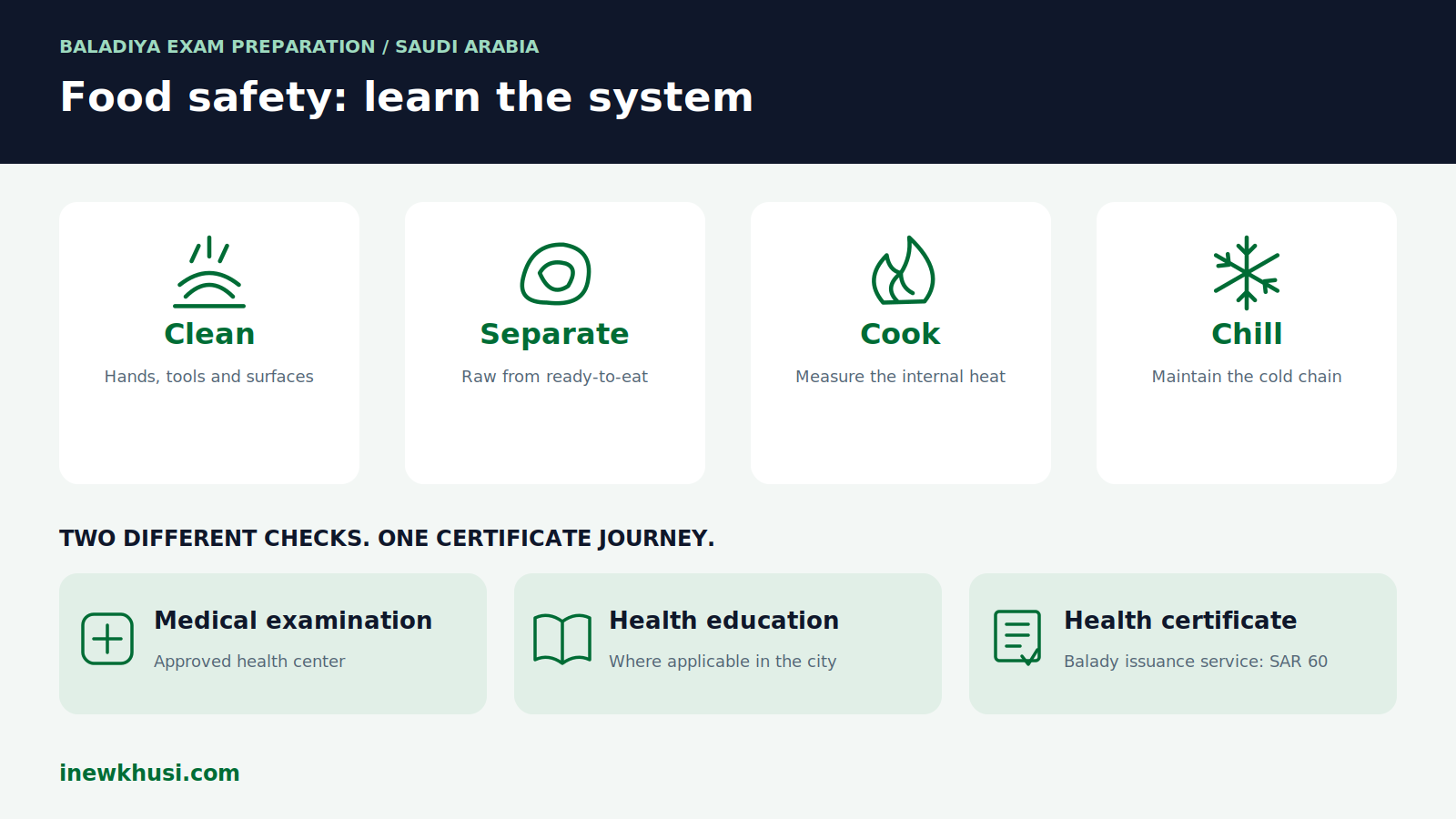
Preparing for Baladiya exam questions and answers can feel confusing when online lists promise “real papers” without explaining the rules. You need practical food-safety knowledge, not unsupported pass guarantees.
This guide gives you original practice questions, Saudi authority guidance and a clear certificate walkthrough. It is independent study material—not an official exam paper or a substitute for your assigned course.
In this guide, you'll discover:
- Twenty questions with short explanations.
- Hygiene and temperature-control essentials.
- Medical, training and certificate requirements.
- Verified fees and sensible next steps.
Let’s dive in.
| Quick fact | What to know |
|---|---|
| Authorities | Ministry of Municipalities and Housing / Balady; SFDA for food-safety guidance |
| Official service | Balady — Issuance of Health Certificate |
| Audience | Workers in food and public-health establishments; Saudi and non-Saudi workers |
| Issuance fee | SAR 60; not an all-inclusive training or medical price |
| Timing | Service card: immediate; prerequisites take additional time |
| Requirements | Approved medical report; health education where applicable |
| Support | Balady: 199040 |
Source basis: Balady issuance service and Contact Us; Ministry certificate service; links in Official Sources & References.
What is the Baladiya food-safety exam?
Here’s the deal: the reviewed pages established no official question bank, universal pass mark or question count. Social-media answers are not official papers.
Baladiya exam questions and answers: 20 practice items
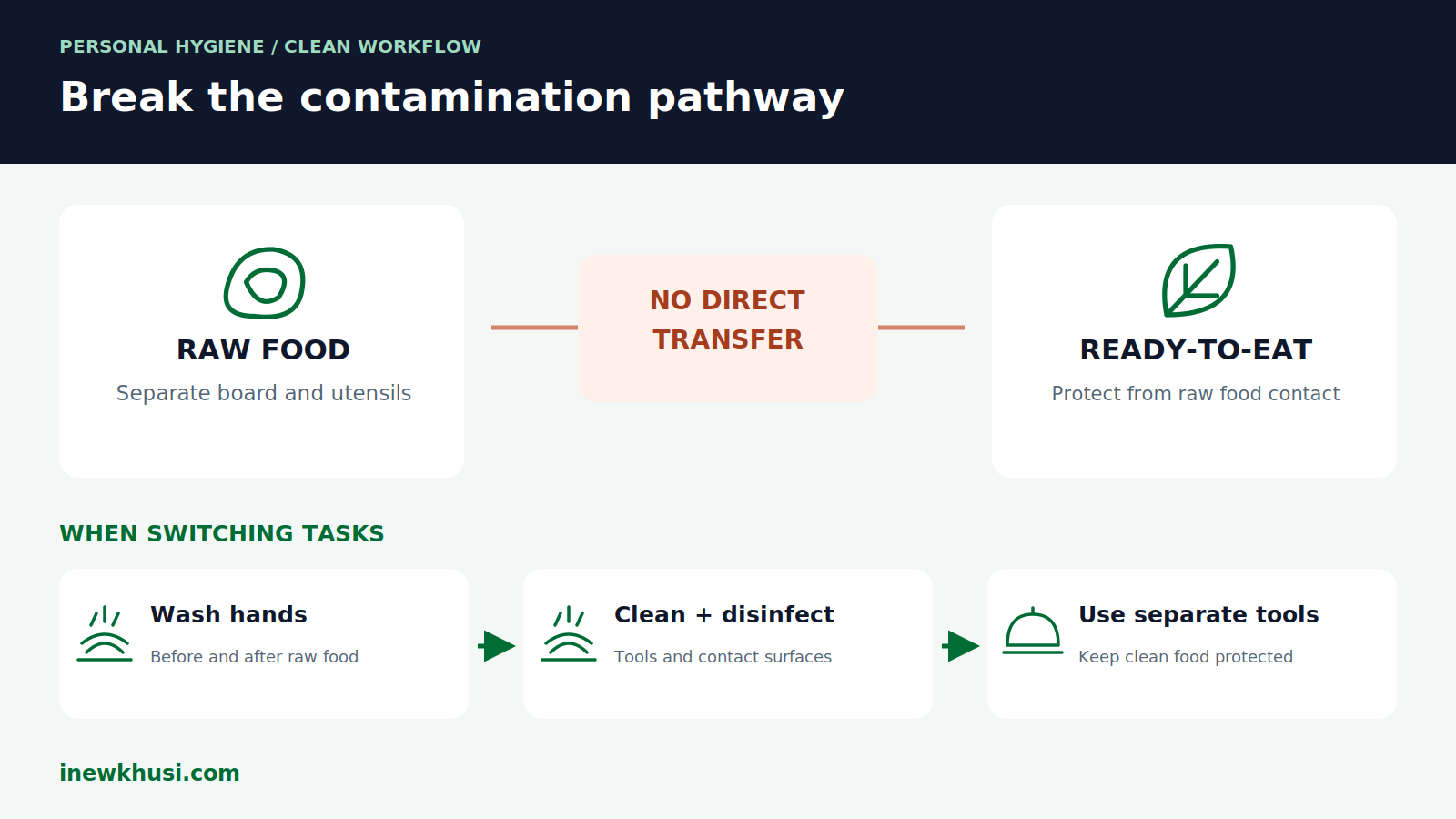
Open each author-written practice item for its answer. These are not government test questions.
01When should you wash your hands around raw meat?
Before and after touching it. Hands can transfer contamination between tasks.
02Can one cutting board serve raw chicken and salad without cleaning?
No. Use separate boards. Salad may receive no further cooking.
03Where should sealed raw meat go in the refrigerator?
Below ready-to-eat food. Contain leaks so they cannot contaminate food below.
04What should a worker with diarrhoea do?
Report symptoms immediately. Do not handle food where contamination is likely.
05How should an exposed cut be protected?
Use a waterproof dressing. Infected wounds also require illness-reporting precautions.
06Can gloves replace personal cleanliness?
No. Maintain personal hygiene. The hygiene requirement applies to every food handler.
07Is smoking acceptable in a food-handling area?
No. The SFDA hygiene document prohibits tobacco use there.
08Can a worker eat over open food while preparing it?
No. Eating, drinking and spitting are prohibited during this work.
09Can detergent be stored in an unlabelled food container?
No. Label and separate hazardous substances. Use secure storage away from food.
10Is wiping a dirty utensil enough?
No. Clean and disinfect as necessary. Use a frequency that prevents contamination.
11Should waste build up until tomorrow?
No. Remove it promptly. The hygiene document also specifies removal by shift or day end.
12What is the right response to pest evidence?
Activate the workplace pest-control procedure. Protect food and prevent animal access.
13Can you thaw meat on the counter?
Use the refrigerator, microwave or cold running water instead. SFDA cautions against thawing in ordinary room air.
14Does a normal smell prove food is safe?
No. Pathogenic bacteria may not alter smell, taste or appearance.
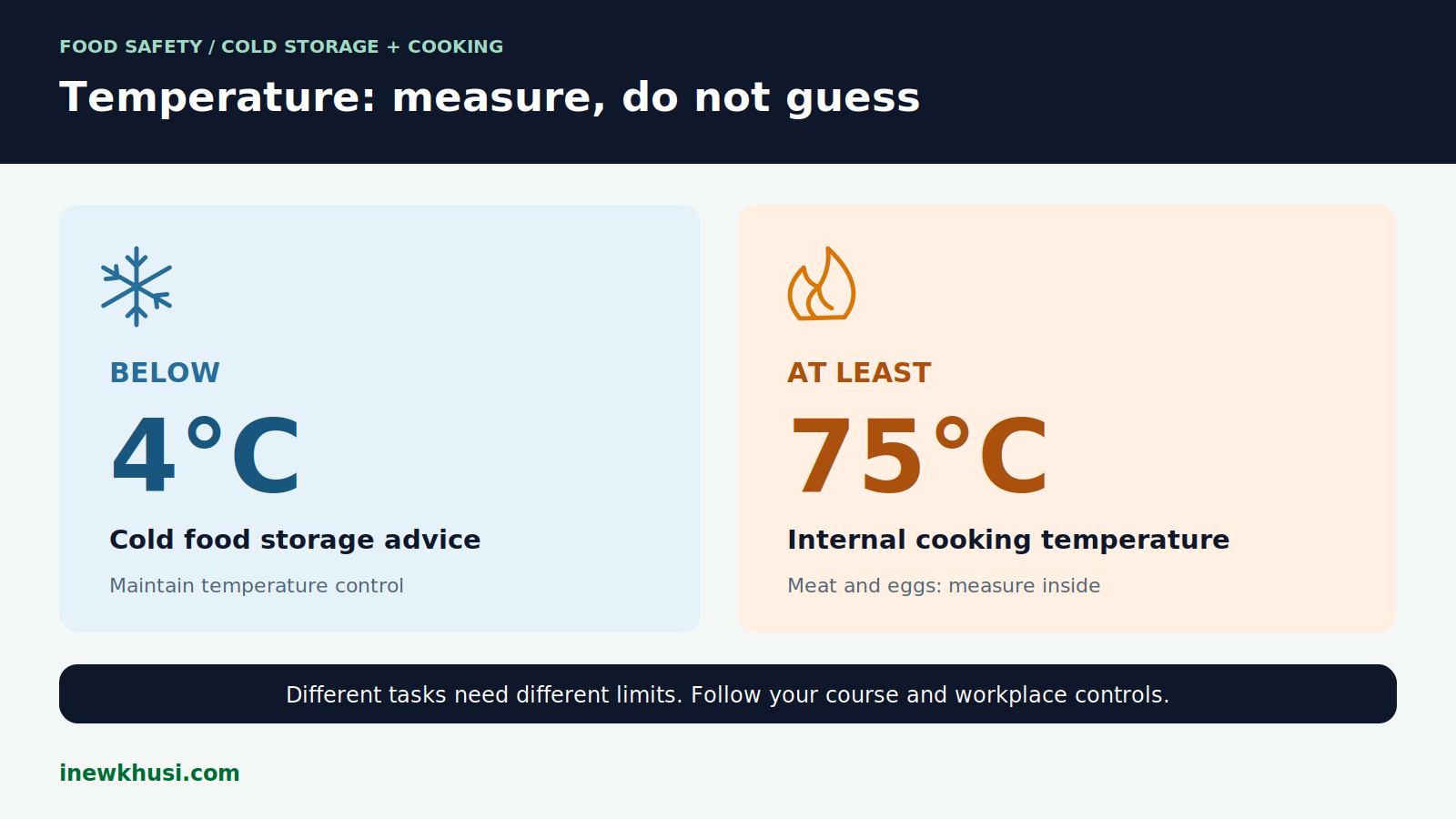
15What internal temperature does SFDA’s 2025 advice give for meat and eggs?
At least 75°C. This is cooking advice, not a refrigerator setting.
16What cold-storage temperature does that 2025 advice recommend?
Below 4°C. Keep this advice distinct from other task-specific limits.
17Should ready-to-eat fruit and vegetables be washed?
Yes, wash them thoroughly. SFDA includes this in contamination-prevention advice.
18Should raw ingredients be identifiable in storage?
Yes, label them for identification. Protect ingredients from contamination and deterioration.
19Can rusty or broken preparation tools be used?
No. SFDA warns that unsafe tools can contaminate food.
20Does passing training alone produce a health certificate?
No. Complete the other required stages. Medical fitness and issuance requirements remain separate.
Which food-safety temperatures should you revise?
| Task | Published advice | Study reminder |
|---|---|---|
| Meat and eggs | Internal temperature ≥75°C | Use the internal reading, not surface appearance |
| Cold storage | Below 4°C | Maintain the cold chain |
| Raw versus ready-to-eat | Keep separate | Temperature does not replace hygiene |
Source basis: SFDA bacteria warning, 12 May 2025; links in Official Sources & References.
Older publications give task-specific holding figures; do not combine them into a universal “danger zone”.
Eligibility and the pre-course checklist
Balady covers food and public-health workers. Municipal procedures check the business license and worker’s profession.
| Item | Status | Practical action |
|---|---|---|
| Medical report | Required | Use a Ministry of Health-approved health center |
| Health education | Required where applicable | Complete the relevant program and pass |
| Business / profession details | Checked in the workflow | Match the establishment and worker records |
| Upload documents | Ministry page lists none | This does not remove the medical-report requirement |
Source basis: Balady and Ministry certificate issuance pages; links in Official Sources & References.
Keep Iqama (Saudi residence permit) records consistent: Iqama & Visa Services guides.
If you are unsure of your residence record, consult the Iqama validity and expiry guide; this is a separate residency task, not an exam prerequisite invented here.
Official fees: do not confuse the exam with issuance
| Charge | Amount in SAR | What it covers |
|---|---|---|
| Certificate issuance | 60 | Balady service-card fee |
| Medical examination | Not fixed by the reviewed service card | Confirm with the approved center |
| Training / assessment / retest | Not fixed by the reviewed service card | Confirm the itemised provider quote |
Source basis: Balady certificate issuance service card; links in Official Sources & References.
Balady lists SADAD (Saudi bill-payment system), Visa, Mastercard, Mada and Apple Pay. Course prices, VAT and refunds are not established here.
How to apply through the Balady certificate service
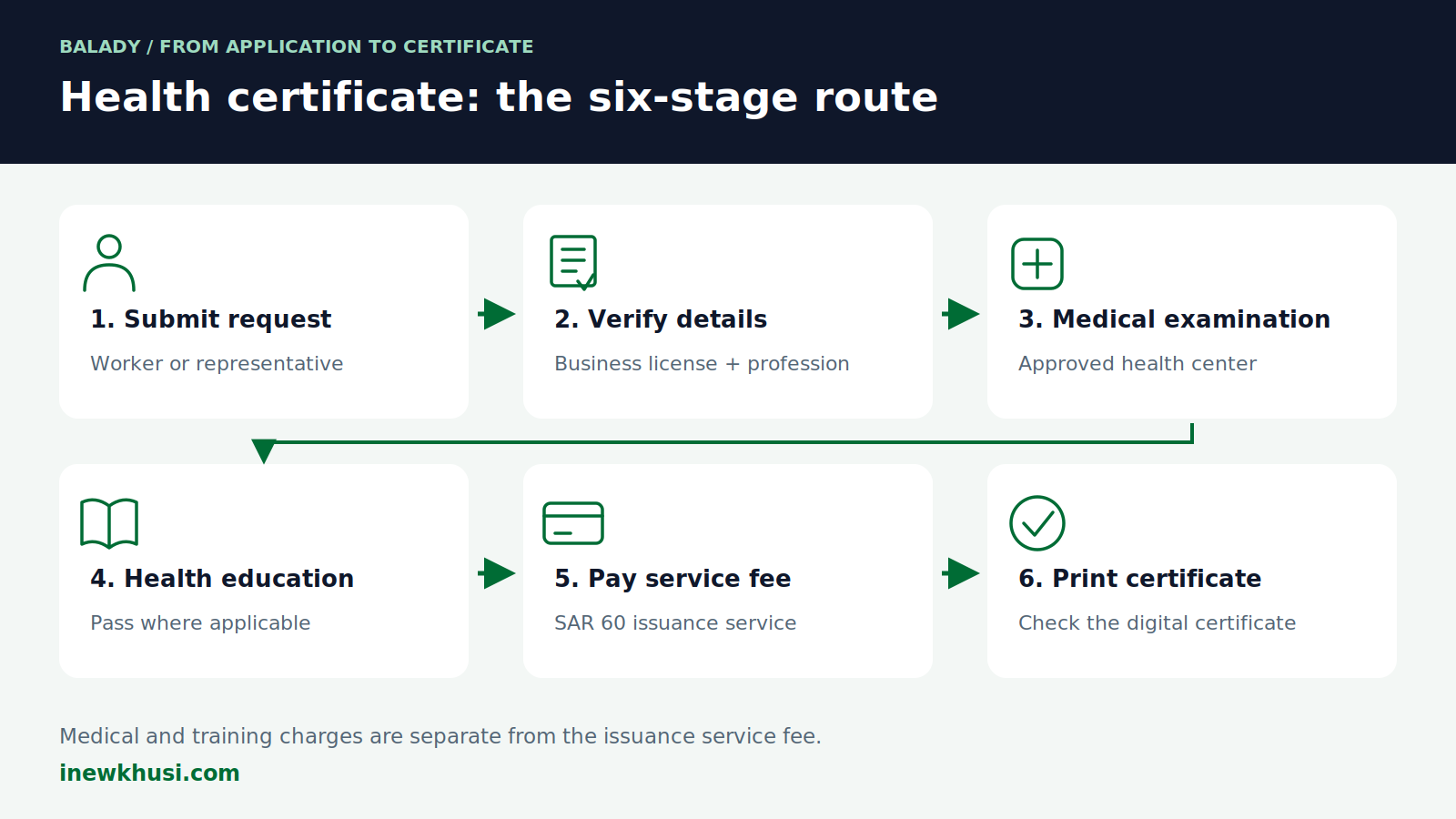
- Step 1 — Open “Issuance of Health Certificate”. Submit through Balady’s portal or app as the worker or an authorised establishment representative.
- Step 2 — Verify establishment and profession details. Follow the municipal checks shown in your application.
- Step 3 — Complete the medical examination. Obtain the approved medical report.
- Step 4 — Pass health education where applicable. Confirm your provider’s appointment, language and assessment instructions.
- Step 5 — Pay the service fee. Use the payment route presented in the application.
- Step 6 — Print the worker’s health certificate. The certificate has an approved digital seal; its QR code supports verification.
These are published stages, not screen-by-screen labels. The multilingual materials viewer requires JavaScript; individual files were inaccessible during review.
Common mistakes and practical fixes
- “Guaranteed real answers”: use the assigned syllabus and reason through scenarios.
- Certificate missing after training: check remaining medical, payment and application stages.
- Record mismatch: compare worker details with official records before contacting support.
- Unclear retest arrangements: request written instructions from your provider.
Check separate residency records with the passport-number Iqama status guide.
For expiry, use the Iqama renewal guide. Training does not renew residency.
Frequently Asked Questions (FAQs)
Are these official Baladiya exam questions?
No. These are original practice questions derived from published Saudi food-safety guidance and Balady’s certificate process. They are not leaked questions, an official answer key or a guarantee of passing. Use your assigned course materials for the assessment’s exact coverage and format.
Is health education mandatory in every Saudi city?
Balady describes the health-education requirement as applicable by city and publishes a list of participating municipalities. Do not assume the requirement is identical everywhere or rely on an old list. Confirm the live service requirements for the worker’s city before arranging training.
What is the pass mark and how many questions are there?
The official pages reviewed did not establish a universal pass mark, assessment length or question count. Claims about a fixed nationwide format are therefore omitted. Ask the assigned provider to confirm the current assessment instructions, supported language, identification requirements and any retest arrangements.
Does the SAR 60 fee include training and the medical test?
No all-inclusive package is established by the Balady service card. It lists SAR 60 for certificate issuance, while the medical report and applicable health education are separate requirements. Confirm any medical, training, assessment or retest charges with the relevant provider before paying.
Can an employer apply for a non-Saudi worker?
Balady says an establishment owner can issue a health certificate for Saudi and non-Saudi workers. The published workflow also allows the worker or an authorised establishment representative to submit. Business-license and profession checks, an approved medical examination and applicable health education still form part of the process.
Can I study in a language other than English?
The official issuance page links a health-education materials guide in available languages. That link opens a JavaScript-enabled Ministry viewer; this review could not inspect the individual language files. Study-material availability does not establish an exam-language guarantee, so confirm the assessment language with the assigned provider.
Conclusion: prepare for safe work, not just a score
The best way to use Baladiya exam questions and answers is to connect each answer with a safe action at work. Separate raw food, report illness and understand temperature controls before you memorise a list.
- Revise the principles: explain every practice answer in your own words.
- Confirm local requirements: check medical fitness and applicable health education.
- Finish issuance: verify the service stages and distinguish the SAR 60 fee from other charges.
Your next action: open Balady’s “Issuance of Health Certificate” service using the first reference below, then follow your assigned provider’s instructions. Which food-safety topic would you like explained in a future update? Share your experience in the comments.
Official Sources & References
- Balady — Issuance of Health Certificate — https://balady.gov.sa/en/services/issuance-health-certificate
- Ministry of Municipalities and Housing — Certificate issuance — https://momah.gov.sa/en/e-services/issuance-health-certificate
- SFDA — Food Hygiene Requirements, Annex II, Chapters V–IX — https://www.sfda.gov.sa/sites/default/files/2020-12/FoodHygieneRequirementsEn.pdf
- SFDA — Bacteria warning and food safety advice (12 May 2025) — https://sfda.gov.sa/en/news/18660
- SFDA — Eight Steps to Prepare Food Safely (11 August 2015) — https://www.sfda.gov.sa/en/awarenessarticle/sfda-8-steps-prepare-food-safely
- SFDA — Food safety frequently asked questions — https://www.sfda.gov.sa/en/faq
- Balady — Contact Us — https://balady.gov.sa/en/form/contact-us
- Ministry health-education materials — JavaScript-enabled viewer — https://sharek.momah.gov.sa/url/nbmpncrsx6kuinxz
All information verified from official Saudi Arabia government and regulatory sources on 6 November 2026.
Review scope: cited service pages and hygiene guidance, not unpublished exam details. Older hygiene principles are not represented as newly issued 2026 rules.
