
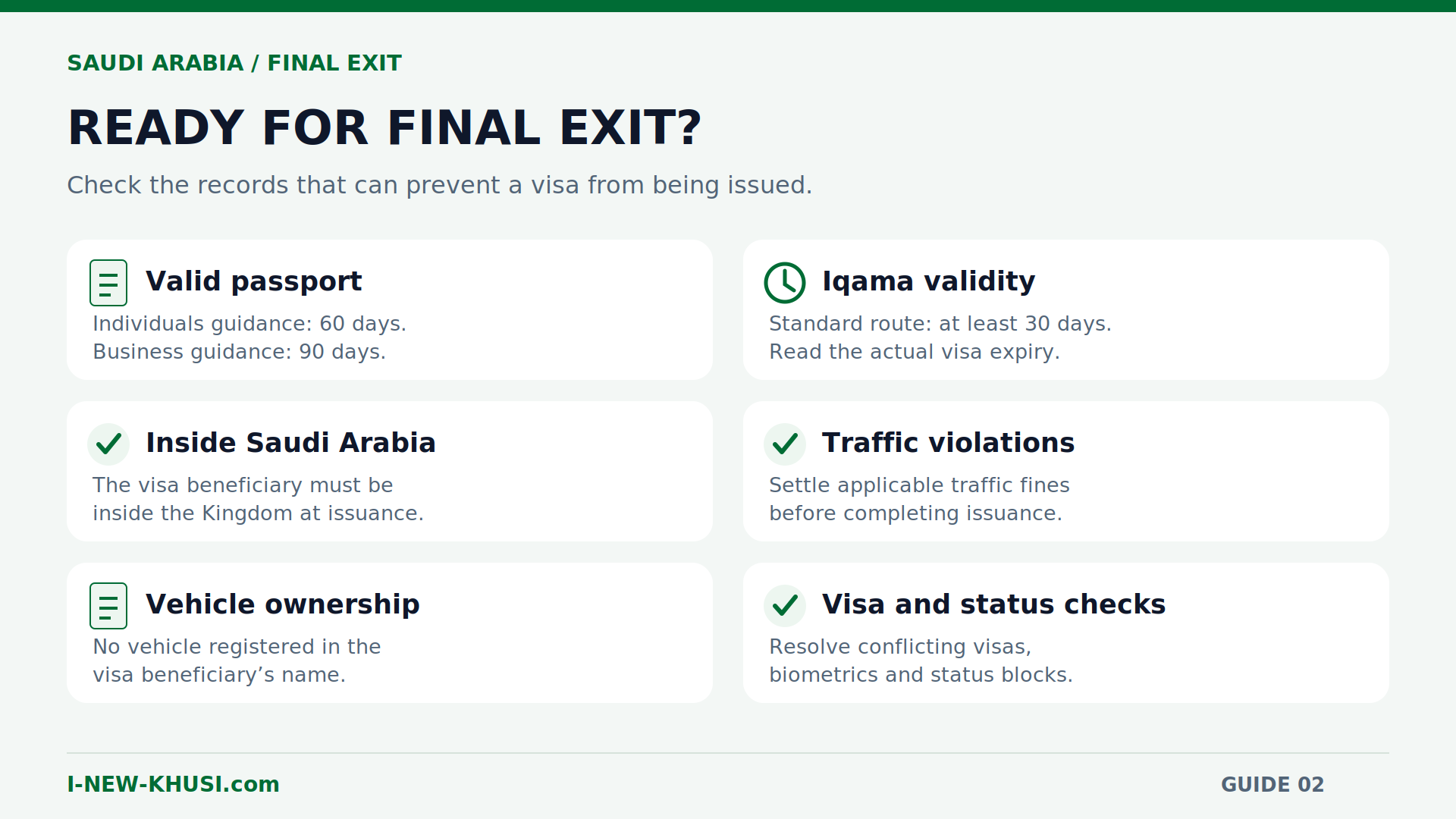
Searching for HRSD final exit because you want to leave Saudi Arabia without a last-minute problem? The confusing part is that labor clearance, a work permit, and the final-exit visa are not the same thing.
This guide explains which route fits your situation, how online issuance works, and which deadlines matter before you book your departure.
In this guide, you'll discover:
- Which authority handles each stage.
- Which conditions can block issuance.
- How employer, family, and domestic-worker routes differ.
- How to protect your final salary and departure deadline.
Let's dive in.
| Item | What to know |
|---|---|
| Authority | Jawazat (General Directorate of Passports): visa; HRSD: labor matters. |
| Portal / app | Absher; Muqeem for employers; Qiwa for relevant labor services. |
| Audience | Residents, workers and sponsored family members; route-specific conditions apply. |
| Visa issuance fee | SAR 0; separate debts and residency costs are not included. |
| Processing | Immediate for eligible automated issuance; disputes and corrections take longer. |
| Core records | Passport, Iqama (residence permit), applicable biometrics and eligible status. |
| Help | HRSD: 19911. Absher e-services: 920020405. |
What does HRSD final exit actually mean?
Final exit, or Khurooj Nihai (permanent departure), is the visa used to end a resident’s stay in Saudi Arabia. HRSD oversees employment and work-permit matters; Jawazat issues the immigration permission through its channels. An HRSD or Qiwa labor transaction alone does not mean your final-exit visa has been issued.
Separate the two stages: resolve labor or permit issues where needed, then complete visa issuance. Qiwa (the labor-services platform) describes a final-exit work permit for cases involving no Iqama or an expired Iqama; this is not the ordinary visa route.
HRSD final exit eligibility and document checklist
| Record / condition | Practical requirement |
|---|---|
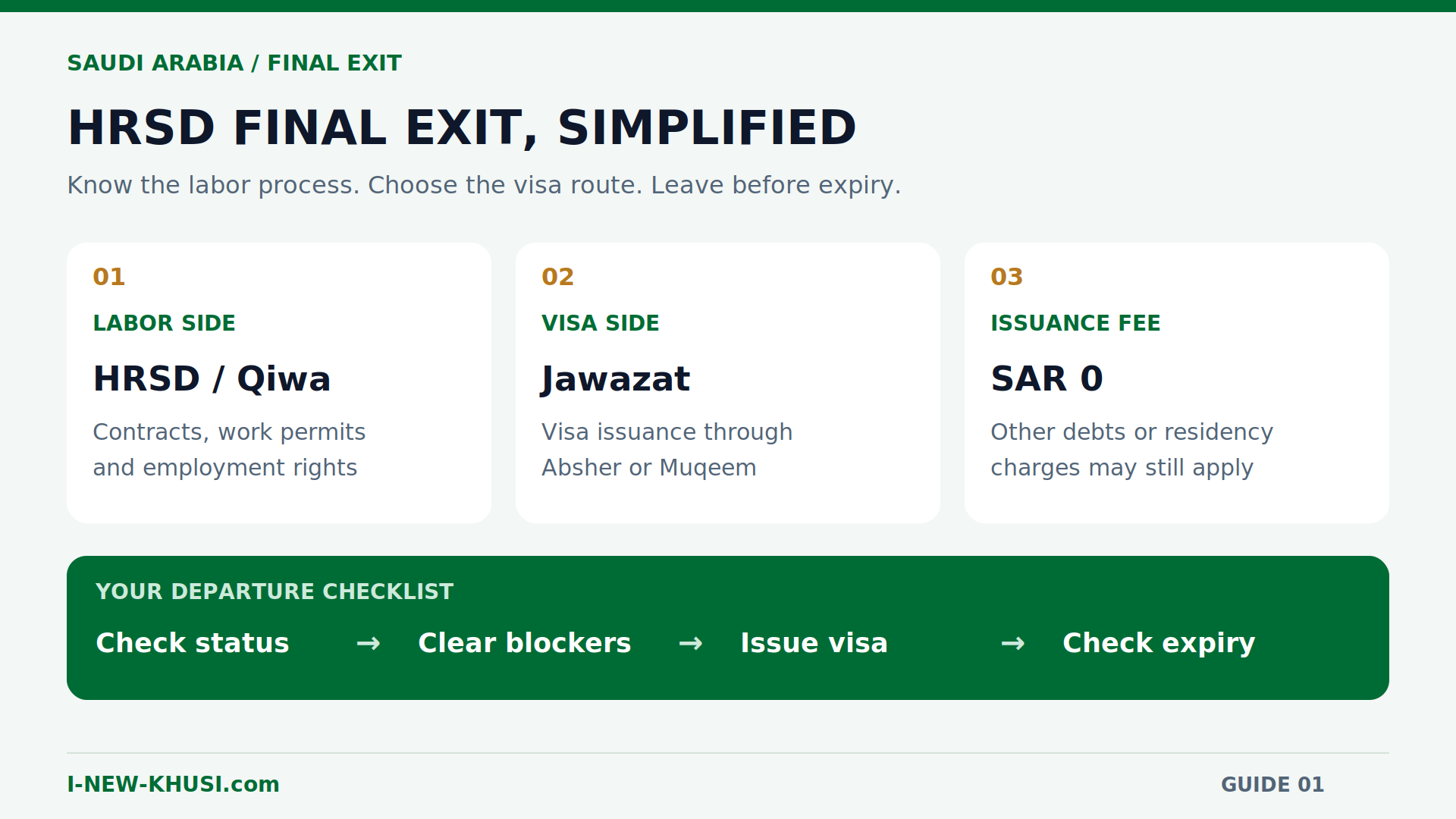
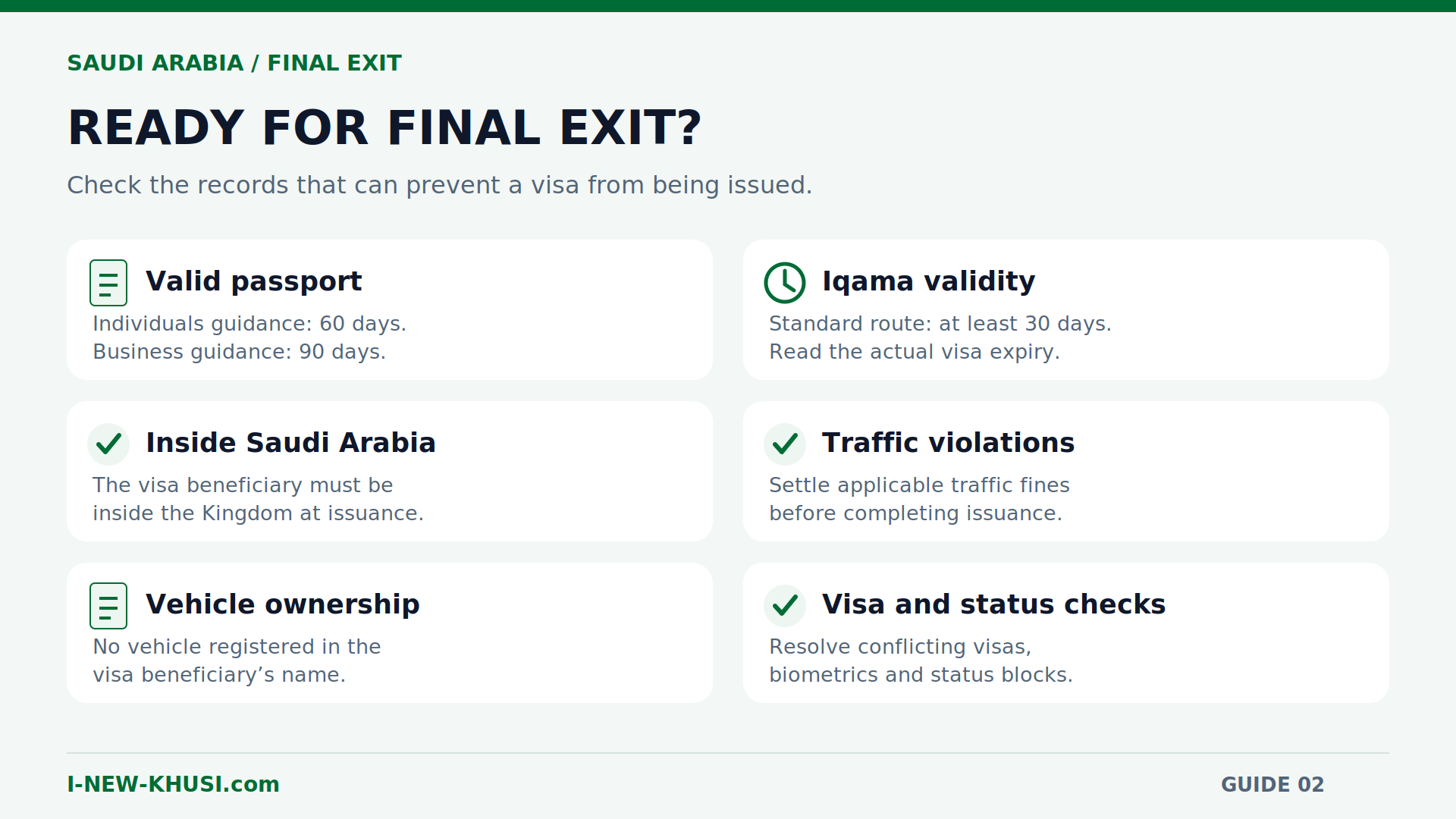
| Passport | At least 60 days in Individuals guidance; Business guidance specifies 90 days. |
| Iqama | At least 30 days for the standard employer / household route; shorter validity requires renewal. |
| Location and biometrics | Beneficiary inside Saudi Arabia; required fingerprints registered. |
| Traffic and vehicles | Pay applicable traffic violations; no vehicle registered to the beneficiary. |
| Visa and status | Resolve an existing valid visa, unused-visa violations or disqualifying status. |
| Employment file | Keep contract, termination records and wage evidence for labor matters. |
Passport rules are route-specific. Use the requirements displayed for your account; do not apply a 60-day Individuals rule to a Business transaction that requires 90 days.
Fees, charges and who pays
| Item | Amount / liability | Payment treatment |
|---|---|---|
| Final-exit visa issuance | SAR 0 | No issuance payment. |
| Ordinary work-permit service | SAR 100 service fee; not a final-exit total | HRSD lists SADAD payment. |
| Permit debts / residency charges | Case-dependent; no universal total stated here | Pay only the assessment for your case. |
| Unused / expired visa penalties | Applicable regulatory fines; no fixed amount quoted here | Follow the authority’s assessment. |
| Return travel: Labor Law cases | Employer normally pays after employment ends; Article 40 exceptions apply | Settle with the employer. |
SADAD (the electronic bill-payment system) is used for the ordinary work-permit service. Do not mistake that fee for a final-exit visa charge, or assume it includes every levy or arrears balance.
How to apply for final exit online
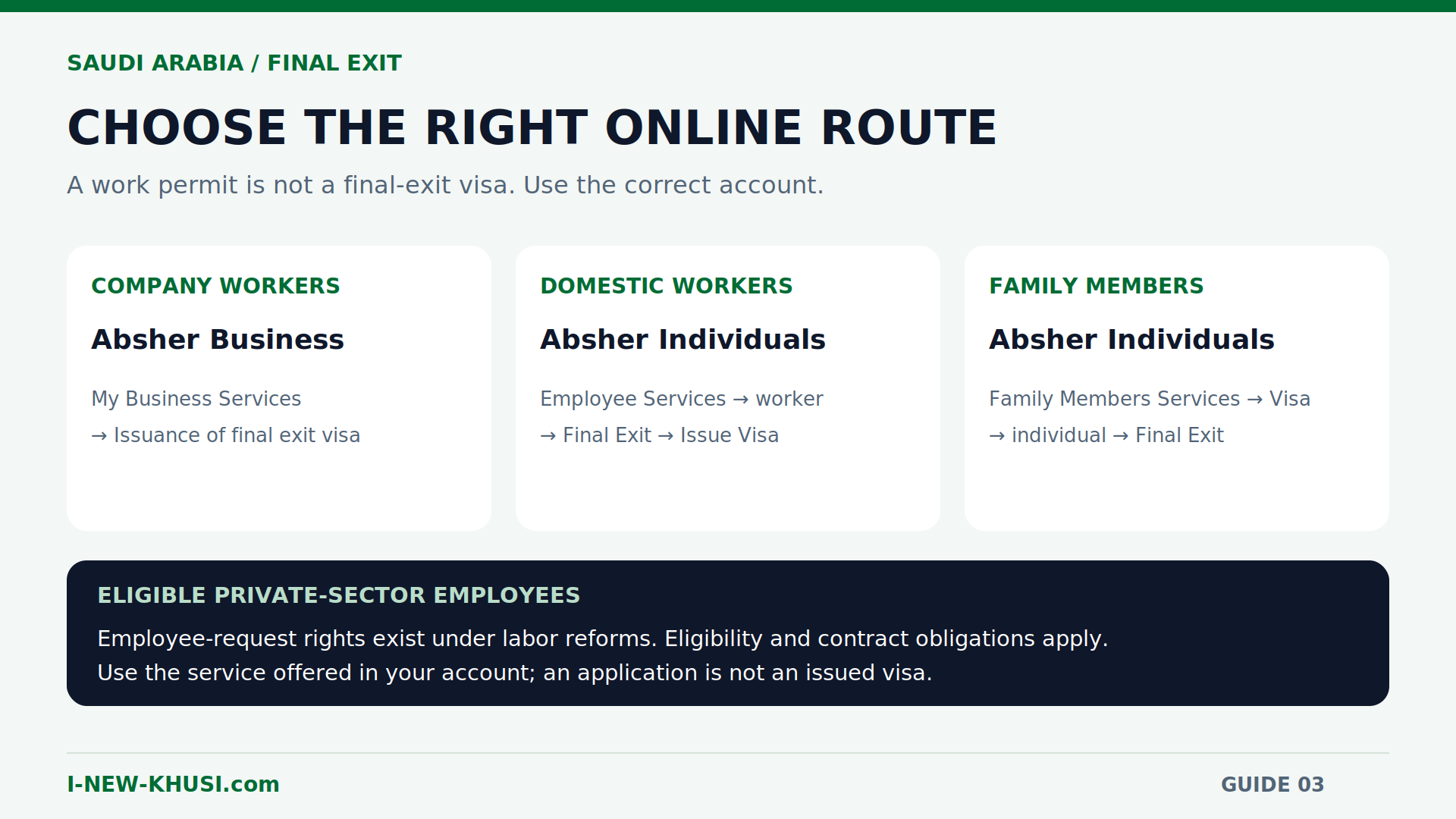
Company workers: employer route
- Step 1: The authorized employer signs in to Absher Business.
- Step 2: Open My Business Services → Issuance of final exit visa.
- Step 3: Select the worker and complete the eligibility checks shown.
- Step 4: Complete issuance, then retain the visa details and expiry date.
Domestic workers and family members
- Step 1: Sign in to Absher. For domestic workers, select Employee Services, then the worker.
- Step 2: For family members, select Family Members Services → Visa, then the individual.
- Step 3: Choose Final Exit, satisfy the displayed requirements, and accept the terms.
- Step 4: Select Issue Visa and retain the confirmation.
Eligible private-sector employees have a separate request right under labor reforms, including departure after contract completion without employer consent and with employer notification. If your own account does not offer the service, ask HRSD to determine your eligibility; do not use an employer-only walkthrough.
How long is a final-exit visa valid?
For the standard employer or head-of-household route, Iqama validity affects the visa duration. Below 30 days, renew first. Above 30 but below 60 days, the visa matches the remaining Iqama validity. At 60 days or more, the visa lasts 60 days. Always follow the expiry on your issued visa.
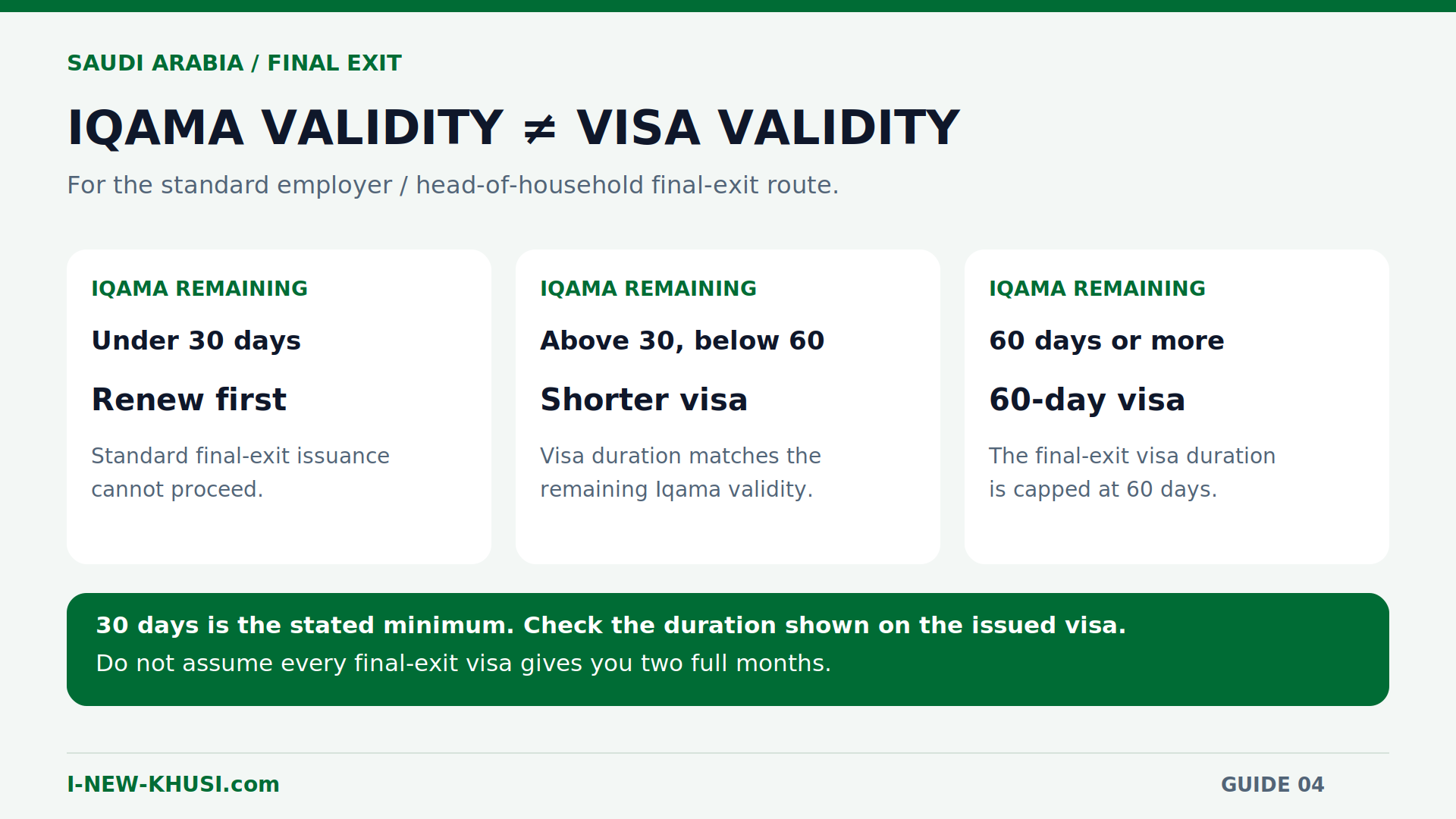
Thirty days is the stated minimum. Confirm the exact duration displayed when your Iqama has precisely 30 days remaining. For ordinary renewal preparation, see the Saudi Iqama renewal guide.
Expired Iqama, absence reports and special cases
An expired Iqama needs a different assessment. Ask HRSD which labor-permit resolution applies, then Jawazat which visa procedure applies. A final-exit work permit is not a guaranteed bypass of passport, status or immigration checks.
Huroob (an absence-from-work report) is not one universal situation. The no-documented-contract absence procedure includes a 60-day transfer-or-exit window. A separate professional-worker correction initiative launched on 18 September 2025 covers specified absence cases, including some after that window, subject to conditions.
Yemeni nationals have a targeted, temporary route: a two-month regularization process began on 11 October 2026. Eligible expired-Iqama holders with valid travel documents who wish to leave may obtain final exit; the announcement states no re-entry restriction for that group. Do not generalize this concession to everyone.
New domestic workers can have a probation route through Absher Individuals during the 90-day period after entry, using a border number and the required visa and biometric records. This is separate from professional-worker reforms.
Rejections, cancellation and practical fixes
| Problem | Next action |
|---|---|
| Iqama too short | Renew for the standard route or obtain case-specific instructions. |
| Passport or biometrics mismatch | Correct the underlying record before resubmitting. |
| Traffic fines / registered vehicle | Settle applicable fines and remove the vehicle-ownership block. |
| Another valid visa / unused-visa violation | Resolve the existing visa record or violation. |
| Wrong worker or passport record | Compare identity details before confirming issuance. |
| Departure plans change | Eligible Business cancellation: My Business Services → Cancellation of final exit visa. |
For cancellation, the beneficiary must remain inside Saudi Arabia. Business guidance describes cancellation within 60 days of issuance; a shorter visa still requires action before its own expiry. An older combined Individuals guide uses different wording, so do not borrow its 90-day window for a final-exit visa.
Protect your salary and employment rights
Visa clearance and final settlement are separate. For Labor Law-covered workers, Article 88 requires settlement within one week after the relationship ends, or within two weeks when the worker terminated the contract. Work-related debts owed to the employer may be deducted.
Keep your contract, wage records and termination evidence. HRSD’s Friendly Settlement is a free first stage for labor disputes; unresolved cases are referred toward the labor-court process within the stated 21-working-day framework from the first lawsuit. It is not a guaranteed visa-resolution deadline.
Frequently Asked Questions (FAQs)
Can I get final exit without employer approval?
Eligible private-sector workers can use the labor-reform right to leave after their employment contract ends without employer consent; the employer is notified. Eligibility still matters, and leaving during a binding contract can have consequences. This right should not be assumed to cover domestic workers or every blocked immigration status.
Can I apply through HRSD instead of Absher?
HRSD handles the labor side, not the visa itself. A work-permit or status-resolution transaction may be necessary for your case, but departure requires the immigration visa. Use the relevant Absher or employer channel for issuance; do not treat an HRSD payment receipt as permission to travel.
Is final exit free in Saudi Arabia?
Visa issuance is free: SAR 0. That does not erase work-permit arrears, residency renewal costs, traffic violations or assessed penalties. Check the charge description and responsible payer. The ordinary SAR 100 work-permit service fee is not a universal final-exit package price and does not establish your total liability.
Can I leave with an expired Iqama?
Not through an assumption that expiry is ignored. The standard employer route requires at least 30 days of Iqama validity. Special labor-permit or status-correction routes need an individual assessment. Ask HRSD and Jawazat which process applies, especially if an absence report or temporary nationality-specific concession affects your case.
Does every final-exit visa last 60 days?
No: the duration can be shorter. On the standard employer or household route, an Iqama with above 30 but below 60 days remaining produces a visa matching that remaining period. At 60 days or more, the visa duration is 60 days. Your actual issued expiry is the deadline to follow.
Can I cancel final exit after leaving Saudi Arabia?
The published Business cancellation service requires the person to be inside the Kingdom. It is not a post-departure reversal service. If plans change before you travel, arrange eligible cancellation promptly and check your residency and employment status separately. Do not rely on a generic cancellation period to extend an already shorter visa.
Your final-exit action plan
HRSD final exit is easier when you separate the labor file from the visa file. Start with your employment status, then check the passport, Iqama and account route before arranging departure.
- Resolve the right issue: labor permits and wages belong to HRSD; visa issuance belongs to Jawazat.
- Read the actual visa: confirm issuance and expiry, rather than assuming a two-month allowance.
- Keep your evidence: retain the visa, payment records and employment-settlement documents.
Start with the correct account and complete only the service that applies to your category. Which part of your final-exit process was the hardest to understand? Share your experience in the comments.
