
Walk into any UAE bank and ask for a credit card, and the very first thing they’ll check is your monthly salary. Here’s the deal: the rules have tightened in recent years, and the “AED 3,000 salary” myth doesn’t hold up the way it used to. Most major UAE banks now expect AED 5,000 per month as the entry-level credit card salary, with premium cards demanding far more.
This guide breaks down exactly what banks look at, how the AECB credit score affects approval, which documents you need, and what your real options are if your salary sits below the typical threshold. By the end, you’ll know which card tier fits your income — and how to apply without wasting an application on a guaranteed rejection.
Quick Answer
The minimum salary for a credit card in the UAE is generally AED 5,000 per month, in line with the Central Bank of the UAE’s minimum annual income guideline of AED 60,000. A few digital and entry-tier cards may consider applicants from AED 3,000–4,000, while premium and signature cards typically require AED 15,000 to AED 30,000+.
What Counts as “Salary” for a UAE Credit Card
Banks don’t just look at the number on your offer letter. They look at net salary credited to a UAE bank account — the figure that actually lands every month after deductions. That’s the number underwriting teams use.
Here’s what typically counts:
- Basic salary plus fixed allowances credited via WPS (Wages Protection System).
- Salary transfer history of at least 3 to 6 consecutive months in many cases.
- Variable bonuses are sometimes considered partially, depending on the bank.
If you’re self-employed, banks usually look at your average bank balance over the last 3 months instead. For example, Emirates NBD asks self-employed applicants to maintain a minimum average balance of around AED 50,000 to qualify in this category.
The Real Minimum Salary by Card Tier
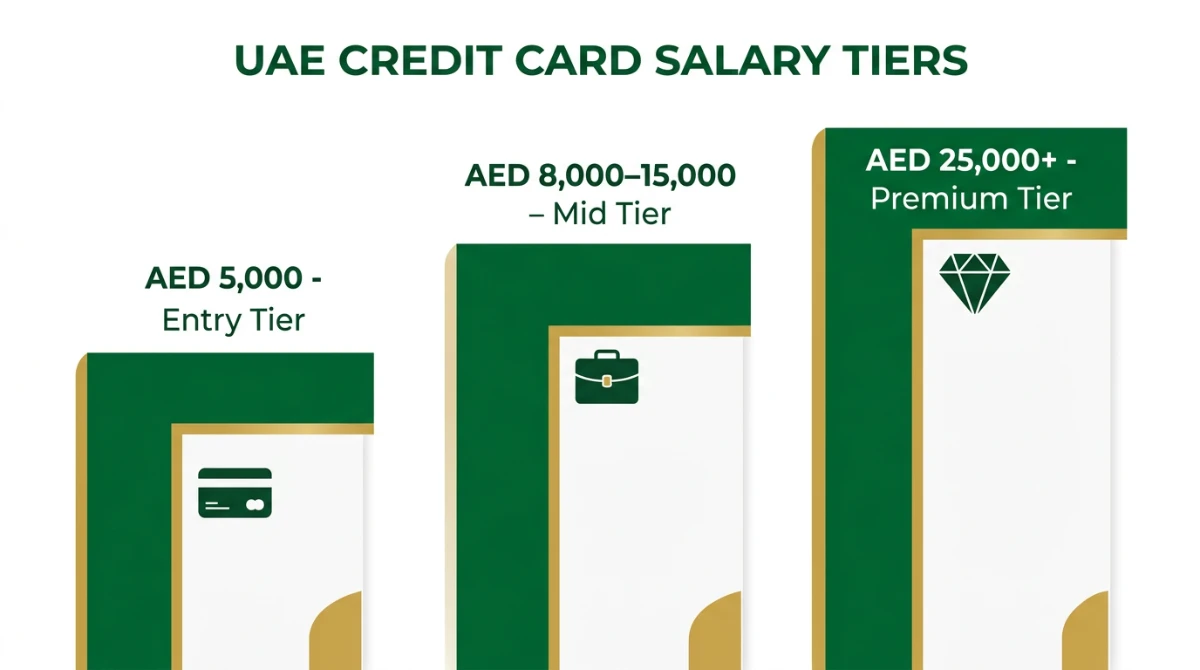
Different cards live in different salary brackets. Picking the wrong tier is the single biggest reason applications get declined.
| Card Tier | Typical Minimum Salary | Card Examples | Best For |
|---|---|---|---|
| Entry / Classic | AED 5,000 (some digital cards from AED 3,000) | Cashback, lifestyle, lifetime-free cards | First-time cardholders, expats new to UAE |
| Platinum | AED 8,000 – 15,000 | Travel, dining, fuel rewards cards | Mid-income salaried professionals |
| Signature / World | AED 15,000 – 25,000 | Airport lounge access, hotel perks | Frequent travellers and senior professionals |
| Infinite / Elite | AED 25,000 – 50,000+ | Concierge, golf, premium miles cards | High-net-worth applicants |
Bank-Wise Minimum Salary Snapshot
Most UAE banks publish their minimum salary openly on each card page. The numbers below reflect what the major issuers list publicly today.
| Bank | Entry-Level Credit Card Minimum Salary | Premium Card Minimum Salary | Salary Transfer Required? |
|---|---|---|---|
| Emirates NBD | AED 5,000 | AED 25,000+ for top-tier cards | Not always — varies by card |
| Mashreq / Mashreq NEO | AED 5,000 (Platinum Plus) | AED 25,000 (Solitaire) | Generally not for NEO cards |
| ADCB | AED 5,000 (with AED 3,000 alt route on some cards) | AED 30,000+ for elite tiers | Optional on most products |
| First Abu Dhabi Bank (FAB) | AED 5,000 | AED 30,000+ for premium variants | Not mandatory on all cards |
| Dubai Islamic Bank (DIB) | AED 5,000 | AED 20,000+ for Platinum/Infinite | Optional |
| Sharjah Islamic Bank (SIB) | AED 5,000 | Varies by card | Sometimes required |
Numbers can shift with promotions and product refreshes, so always confirm on the bank’s official card page before submitting an application.
Why Banks Set a Minimum Salary at All
The minimum salary isn’t arbitrary. It comes from a mix of regulatory guidance and bank risk policy.
The Central Bank of the UAE has long signalled that credit cards should generally be issued to individuals with a minimum annual income of around AED 60,000 — which works out to roughly AED 5,000 per month — unless the card is fully secured by a deposit.
From the bank’s side, the salary cut-off does three things:
- Filters repayment ability: A predictable monthly inflow proves the cardholder can clear bills on time.
- Caps debt-burden ratio: UAE rules limit total monthly EMI exposure (including 5% of credit card limit) to 50% of salary.
- Reduces default risk: Stable income lowers the chance of charge-offs, which protects both the bank and you.
Eligibility Beyond Salary: What Really Decides Approval
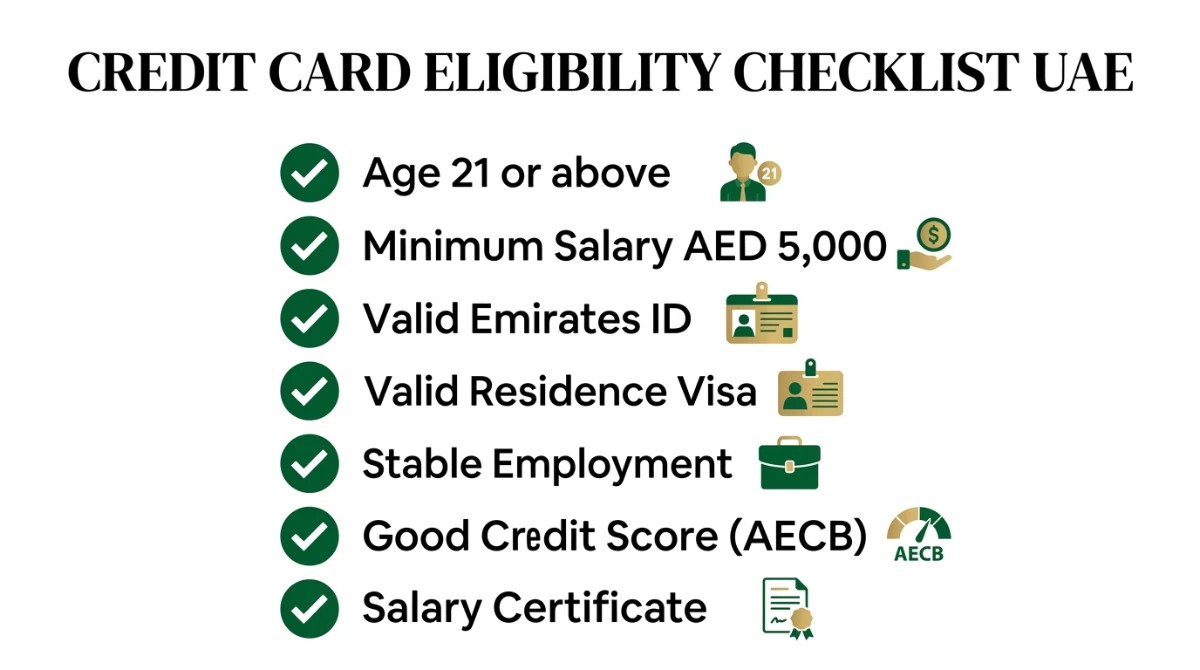
Hitting the salary threshold gets your foot in the door. Approval depends on a wider checklist:
- Age: Usually 21 years and above (some banks 18+).
- Residency: Valid UAE residence visa for expats; Emirates ID is mandatory.
- Employment status: Salaried with a stable employer is the easiest path; self-employed applicants face stricter checks.
- AECB credit score: A score above 620–650 noticeably improves approval chances; above 700 unlocks better limits and rates.
- Existing debt load: Total monthly liabilities should stay well within the 50% debt-burden ratio rule.
- Employer list: Many banks maintain internal “listed company” databases. Working for a listed employer often eases approval.
One missed loan EMI or a heavy buy-now-pay-later footprint on your AECB report can sink an otherwise solid application — even at a comfortable salary.
Documents You’ll Need to Apply
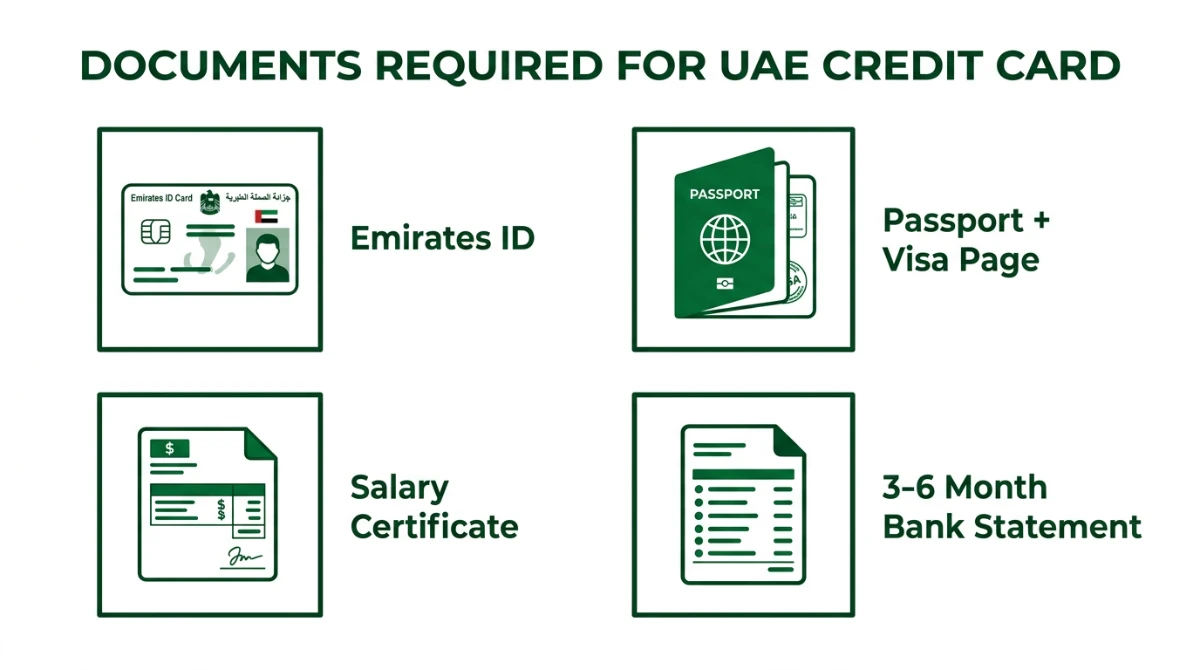
Bank checklists are largely standardised. Have these ready before you start:
| Document | Why It’s Needed |
|---|---|
| Valid Emirates ID | Identity verification, mandatory for all UAE residents |
| Passport copy with residence visa page | Proof of legal stay for expats |
| Salary certificate / employment letter | Confirms current job, tenure and gross salary |
| 3 to 6 months of bank statements | Shows actual salary credit pattern and spending behaviour |
| Tenancy contract or DEWA/SEWA bill | Address verification (some banks) |
| Trade licence + audited financials | Required if you’re self-employed or a business owner |
Credit Card Options When Salary Is Below AED 5,000
Below the AED 5,000 mark, you’re not out of options — but the playbook changes.
Path 1: Secured / deposit-backed credit card. You place a fixed deposit (typically AED 3,000 to AED 5,000) and the bank issues a card against it. Your credit limit is usually 80–90% of the deposit. It’s the most reliable route for low-salary or new-to-UAE applicants.
Path 2: Existing relationship leverage. If your salary is credited to a bank where you also hold savings or a fixed deposit, you may qualify for a card the bank wouldn’t otherwise issue. For salary planning at this level, our UAE salary calculator and finance options for AED 3,000 to AED 5,000 earners walks through what realistic numbers look like.
Path 3: Digital-first lifetime-free cards. A handful of digital-only cards advertise low or flexible salary thresholds. Read the fine print: many still pull a hard AECB check and can decline you despite the headline number.
Path 4: Build a clean banking record first. Six months of consistent salary credit and a healthy bank balance often does more than a single application. If you’re still setting up your banking life, start with a strong base account — our guide to zero balance bank accounts in the UAE is a useful starting point.
Salary Transfer vs Non-Salary Transfer Cards
Banks split credit cards into two big buckets, and the salary requirement often differs between them.
| Feature | Salary Transfer Card | Non-Salary Transfer Card |
|---|---|---|
| Minimum salary | Often lower (from AED 5,000) | Often higher (from AED 7,000–10,000) |
| Approval ease | Higher — bank sees your full financials | Stricter — relies more heavily on AECB |
| Credit limit | Up to 4x salary commonly | Usually 2x–3x salary |
| Welcome offers | Often more aggressive | Standard offers |
| Switching cost | Bank may reduce limit if salary stops | No dependency once approved |
Bottom line: if you’re comfortable with your bank, salary-transfer cards usually offer more value. If you prefer flexibility, non-salary-transfer cards work — just expect a higher income bar.
How to Apply for a UAE Credit Card the Right Way
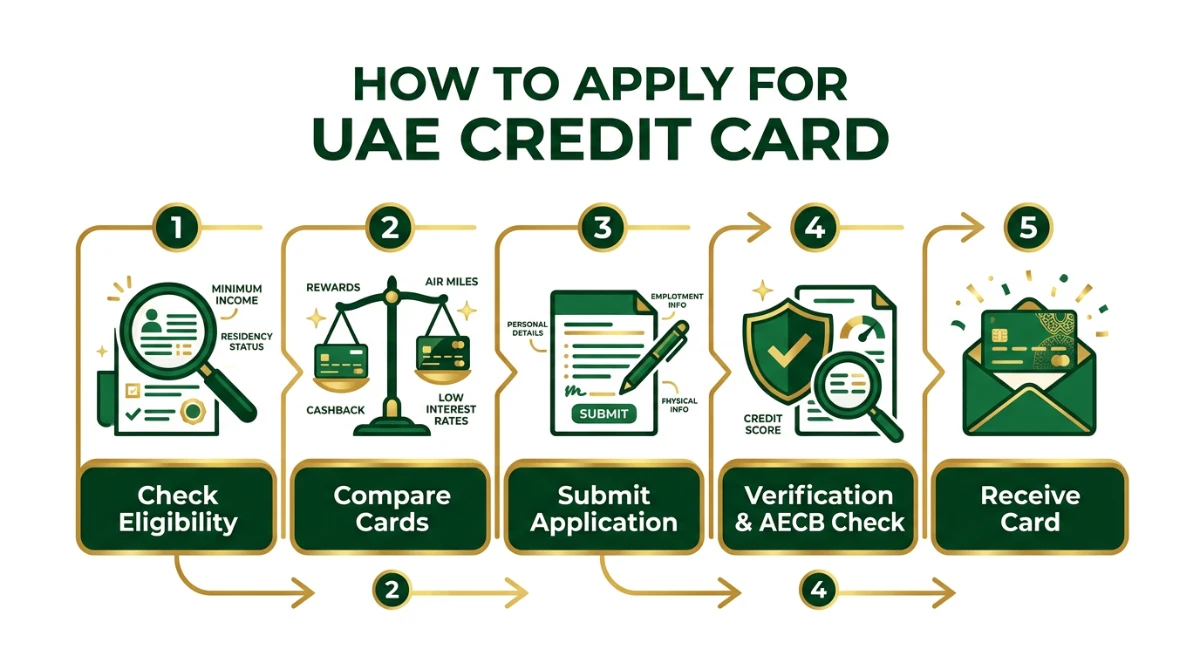
The actual process is faster and less painful when you prepare in the right order.
Step 1: Run an honest eligibility check
Confirm your salary, residency status, age, and employer category. If your AECB score is unknown, request your free annual report from the AECB app before applying.
Step 2: Compare cards within your salary tier
Look at annual fees, joining bonuses, cashback caps, lounge access, and minimum spend conditions. Don’t pick a card on the welcome offer alone — recurring benefits matter more.
Step 3: Submit a clean application
Most banks accept fully digital applications with Emirates ID e-KYC. Upload clear documents. Mismatched names, blurry IDs and outdated tenancy contracts are common rejection triggers.
Step 4: Allow verification and AECB pull
The bank will pull your AECB report and may call your employer for HR confirmation. Approval typically takes 2 to 5 working days, sometimes faster for existing customers.
Step 5: Receive, activate, and use responsibly
Cards are usually delivered within 3 to 7 working days after approval. Activate using the bank app or hotline, set a strong PIN, and enable transaction alerts on day one.
Common Mistakes That Get UAE Credit Card Applications Rejected
Even applicants well above the minimum salary get declined. Here are the patterns banks flag most often:
- Salary not yet credited via WPS for the required number of months.
- High existing personal loan or auto loan EMIs pushing the debt-burden ratio above 50%.
- Unpaid or late credit card minimum dues showing on the AECB report.
- Employer not on the bank’s “approved companies” list.
- Mismatch between salary certificate amount and actual bank statement credits.
- Incomplete documents — especially missing visa pages or expired Emirates ID.
Fix these before reapplying, and approval rates climb sharply.
Smart Tips to Improve Your Approval Odds
- Build six months of clean salary history in the same bank before applying.
- Keep utilisation low on any existing card — under 30% of the limit is ideal.
- Pay every minimum due in full for at least 6 months before a new application.
- Limit BNPL usage in the months leading up to your application — heavy BNPL footprints can trigger declines.
- Avoid card hopping. Spread applications by at least 3 to 6 months.
- Pre-check your AECB via the official app and dispute any errors before applying.
Frequently Asked Questions
What is the absolute minimum salary to get a credit card in the UAE?
The standard minimum is around AED 5,000 per month, aligned with the Central Bank of the UAE’s indicative minimum annual income of AED 60,000 for unsecured credit cards. A few digital and entry-tier cards may consider applicants from AED 3,000–4,000, but approvals at that level depend heavily on AECB score, employer category and existing banking relationship.
Can I get a credit card with a salary of AED 3,000?
It’s possible but limited. Your strongest options are secured (deposit-backed) credit cards, supplementary cards on a family member’s account, or select digital cards that explicitly accept lower-income applicants. Approval still depends on a clean AECB report, valid residency and a stable job. Many banks will quietly decline AED 3,000 applicants for unsecured cards regardless of advertised limits.
Is salary transfer mandatory for a UAE credit card?
Not always. Many UAE banks offer both salary-transfer and non-salary-transfer cards. Salary-transfer cards usually have lower minimum salary requirements and better welcome offers. Non-salary-transfer cards typically demand a higher income (often AED 7,000–10,000+) and rely more on your AECB score for approval.
How much credit limit will I get on a AED 5,000 salary?
Banks usually grant a credit limit between 1.5x and 3x your monthly salary for entry-level applicants — so roughly AED 7,500 to AED 15,000 on a AED 5,000 income. The exact figure depends on your AECB score, debt-burden ratio, and whether the card is salary-transfer based. Limits can be reviewed upward after 6–12 months of clean repayment behaviour.
Does AECB score really impact credit card approval in UAE?
Yes, significantly. The Al Etihad Credit Bureau report is one of the first things underwriters check. A score under 620 often leads to outright rejection, while scores above 700 unlock better cards, higher limits and faster approvals. Late payments, defaults, and high credit utilisation all drag the score down and make approval harder regardless of salary.
Can self-employed applicants qualify for UAE credit cards?
Yes, but the bar is different. Instead of a salary slip, banks usually want a valid trade licence, audited financials, and a healthy average bank balance — often AED 50,000 or more over the last three months. Some banks also accept fixed-deposit-backed cards as an easier route for self-employed applicants and small business owners.
How long does UAE credit card approval take?
For most digital applications submitted with complete documents, approval takes 2 to 5 working days. Existing bank customers with salary already on file can sometimes be approved within hours. Card delivery typically follows in another 3 to 7 working days, after which you’ll need to activate it via the bank’s app, online banking, or customer care hotline.
What happens to my credit card if I lose my job in UAE?
If your salary stops being credited, the bank may reduce your credit limit, freeze new spending, or call the outstanding balance for early settlement, especially on salary-transfer cards. Inform the bank early, request a hardship plan or restructured repayment, and keep paying at least the minimum due. Going silent and missing payments triggers AECB damage and possible legal action.
Final Takeaway
The realistic minimum salary for a credit card in the UAE today is AED 5,000 per month, with everything below that pushing you into secured cards or specialist digital products. Salary, however, is just the entry ticket — your AECB score, existing debt, employer category, and document quality decide whether the bank actually says yes.
The smart play is simple: pick a card whose tier matches your income, clean up your AECB report before applying, and apply to one bank at a time. A single well-prepared application beats four rushed ones every time.
If you want to plan around a specific salary band, start with a clear view of your monthly cash flow and existing obligations, then choose the card that fits — not the one with the loudest welcome bonus.
Sources
- Central Bank of the UAE — credit card consumer regulations
- Emirates NBD — Eligibility and documents for credit cards: https://www.emiratesnbd.com/en/help-and-support/eligibility-and-documents-for-credit-cards
- Mashreq UAE — Credit cards: https://www.mashreq.com/en/uae/neo/cards/credit-cards/
- ADCB — Choosing the right credit card tier: https://www.adcb.com/en/consumer-education-awareness/starting-out/choosing-the-right-credit-card-tier
- First Abu Dhabi Bank — Credit cards: https://www.bankfab.com/en-ae/personal/credit-cards
- Dubai Islamic Bank — Cards: https://www.dib.ae/personal/cards
- Al Etihad Credit Bureau (AECB) — Credit report and score: https://aecb.gov.ae/
Last verified: May 2026. Bank policies and salary thresholds change without notice — always confirm on the official bank page before applying.
