
Saving money in the UAE feels easy on paper — until your salary lands and most of it disappears in rent, groceries, school fees, and weekend plans. Here’s the deal: if you don’t see your savings on a timeline, you don’t treat them seriously.
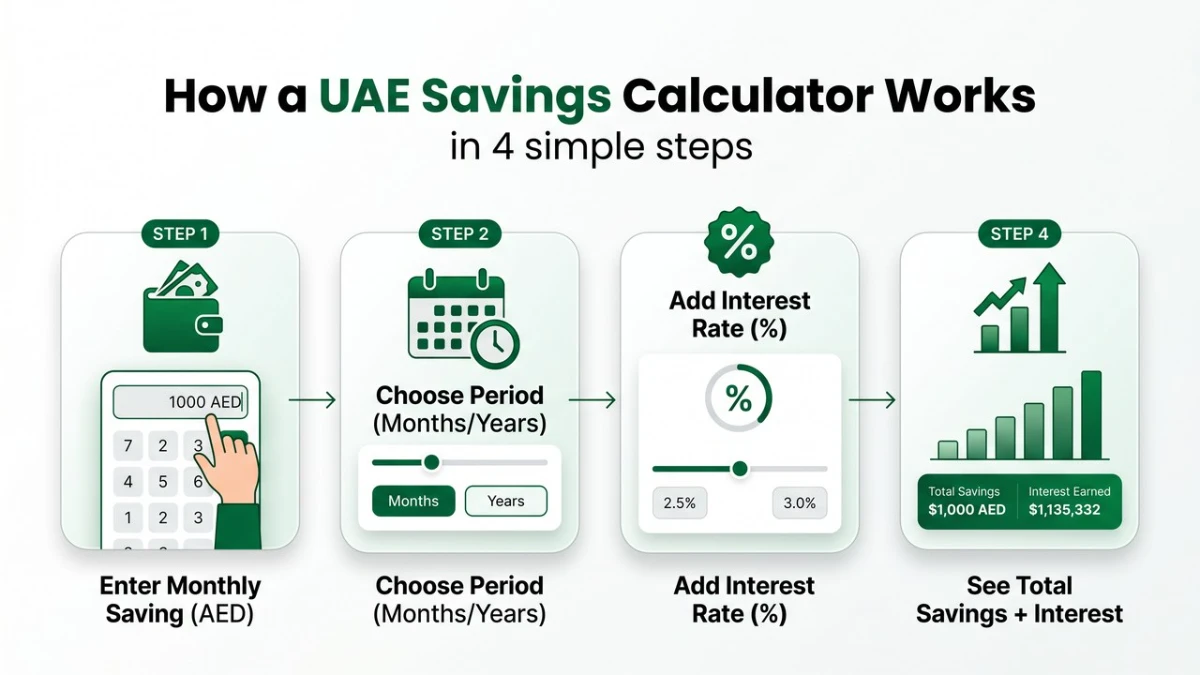
That’s exactly the gap a UAE savings calculator fills. You enter your monthly amount, choose a period, add a realistic interest rate, and instantly see what your money becomes after months or years. The good news? You don’t need a finance degree to use it. This guide shows you how the calculator works, how to read its output, and how to turn it into a real saving plan in AED.
Quick Answer
A UAE savings calculator estimates how much your monthly savings will grow over a chosen period at a given interest rate. You enter the monthly AED amount, the term (months or years), and the annual interest rate, and the tool returns the total deposits, total interest earned, and final maturity value.
What Is a UAE Savings Calculator?
A UAE savings calculator is a small financial tool that projects how a series of monthly deposits will grow over time when an interest rate is applied. It is built for residents of Dubai, Abu Dhabi, Sharjah and other Emirates who want a quick AED-based view of their money.
Most calculators use one of two methods:
- Simple interest — interest is calculated only on the deposits you make.
- Compound interest — interest is also earned on the interest already added to your balance.
The calculator on the reference page lets you enter a monthly saving amount in AED, choose months or years, set an annual interest percentage, and see your final balance instantly. It is great for planning, not for guaranteeing returns.
Why People in the UAE Use a Savings Calculator
Most users open a savings calculator with a real-life decision in mind. Bottom line: they want clarity before they commit money each month.
- Setting a goal for a wedding, Hajj, family trip, or down payment.
- Comparing what AED 500, AED 1,000 or AED 2,000 monthly can build over 3, 5, or 10 years.
- Choosing between a regular savings account, a recurring deposit, or a goal-based account.
- Checking whether the bank’s advertised interest rate is actually meaningful for them.
- Planning end-of-service savings, retirement targets, or a return-home corpus.
The calculator turns vague intentions into a number you can defend in front of yourself — and that’s usually what triggers consistent saving.
Inputs You Need Before You Start
Before you click Calculate, gather three small pieces of information. The result is only as honest as the inputs.
| Input Field | What to Enter | Tip |
|---|---|---|
| Monthly Saving Amount (AED) | The realistic amount you can save every month after expenses. | Start with a number you can repeat for 12 months without stress. |
| Period Type | Months or Years. | Use Years for goals beyond 24 months — easier to read. |
| Period Value | How long you plan to save (e.g. 36 months or 5 years). | Match it to a real goal date. |
| Annual Interest Rate (%) | The rate offered by your savings account or RD. | Use the bank’s actual published rate, not a wishful number. |
How the Calculation Actually Works
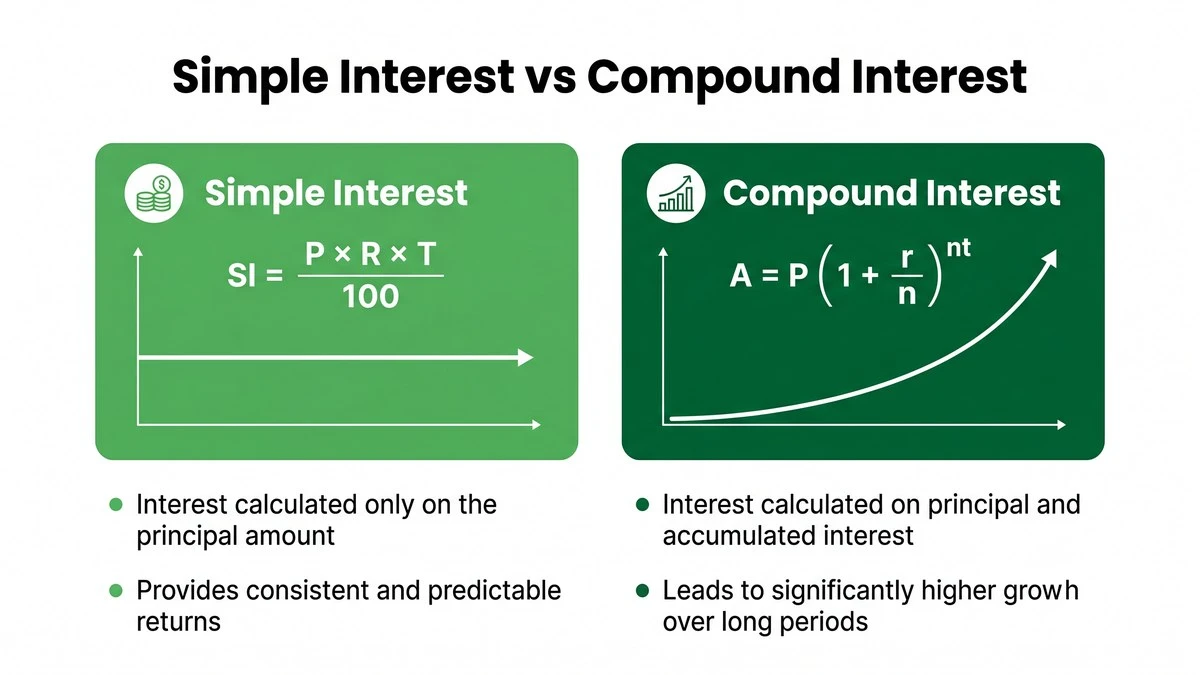
Two formulas drive almost every savings calculator you’ll see in the UAE.
Simple Interest
Interest is calculated only on the principal you deposit.
Formula: SI = (P × R × T) / 100
Where P is the principal, R is the annual rate, and T is the time in years. It’s easy to understand but slower to grow your money.
Compound Interest
Interest is added to the balance, and the next round of interest is calculated on that new, larger balance.
Formula: A = P (1 + r/n)^(nt)
Here, n is the number of times interest is compounded per year. Most savings products in the UAE compound monthly or quarterly, which boosts long-term growth.
Step-by-Step: How to Use the UAE Savings Calculator
You can complete this in under two minutes once your inputs are ready.
- Open the calculator on a desktop or mobile browser. No login is needed.
- Enter your monthly saving amount in AED. Be honest — use a number you can repeat every month.
- Pick the period type — Months for short goals, Years for long-term planning.
- Enter the period value matching your goal date.
- Add your annual interest rate. Take this from your bank statement, app, or rate card.
- Click Calculate. Read the total deposits, interest earned, and final maturity amount.
- Adjust and re-run. Try a higher monthly amount or a longer period to see the effect.
If you want to compare different banks or scenarios, save the numbers in a notes app and run two or three versions side by side. That single habit changes how you look at saving in the UAE.
Realistic Savings Projections in AED
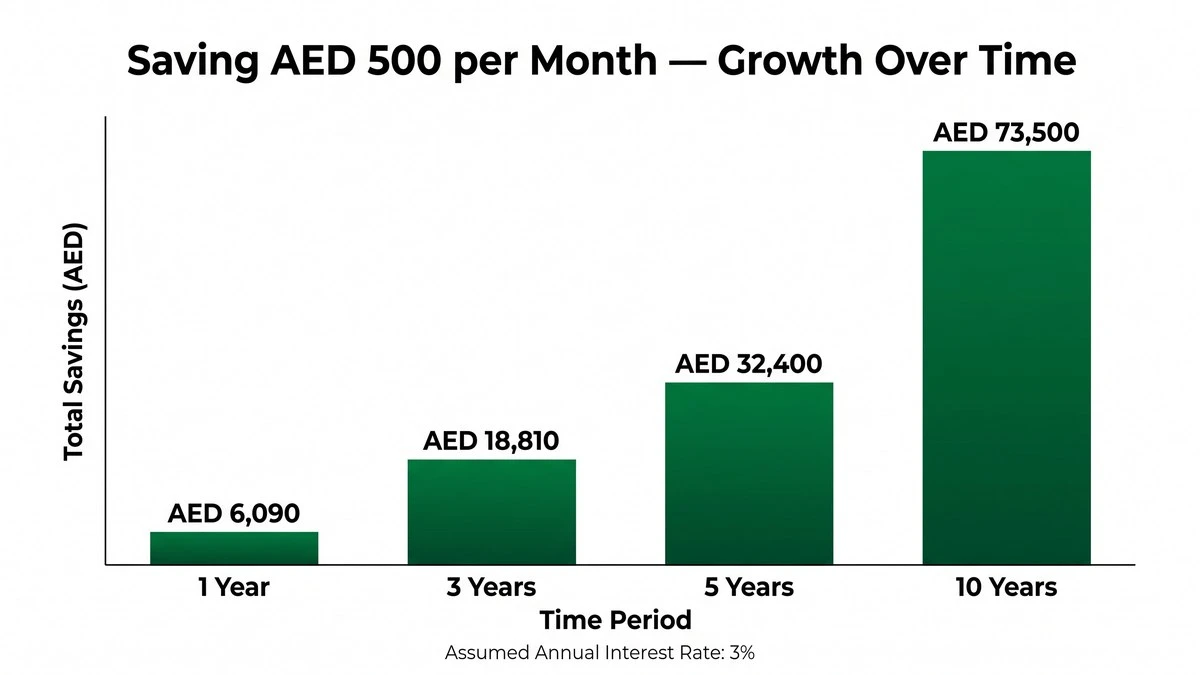
The table below shows estimated balances assuming a flat 3% annual rate, monthly compounding, and consistent deposits. Numbers are rounded for readability and do not reflect any specific bank product.
| Monthly Saving | After 1 Year | After 5 Years | After 10 Years |
|---|---|---|---|
| AED 500 | ~AED 6,090 | ~AED 32,400 | ~AED 73,500 |
| AED 1,000 | ~AED 12,180 | ~AED 64,800 | ~AED 147,000 |
| AED 2,000 | ~AED 24,360 | ~AED 129,600 | ~AED 294,000 |
| AED 5,000 | ~AED 60,900 | ~AED 324,000 | ~AED 735,000 |
Two clear takeaways:
- Time, not the rate, does most of the heavy lifting in early years.
- Doubling your monthly amount doubles your final balance — so small upgrades matter.
Once you have a target, pair it with the right account. Our roundup of top savings accounts in the UAE can help you decide where to park your monthly contribution.
Common Mistakes to Avoid
A calculator is only useful if you feed it real data. Watch out for these traps:
| Mistake | Why It Hurts | Better Approach |
|---|---|---|
| Using a wishful interest rate | Inflates your forecast and breaks trust. | Use your bank’s actual current rate. |
| Ignoring monthly fees | Fees quietly eat into the maturity amount. | Pick low-fee or zero-balance accounts where possible. |
| Treating the result as guaranteed | Rates and bonuses can change. | Re-check every 6–12 months. |
| Saving without a goal | You stop the moment life gets expensive. | Tie the number to a clear target. |
| Mixing emergency and long-term funds | You raid the long-term pot too easily. | Use separate accounts or buckets. |
Smart Saving Tips for UAE Residents
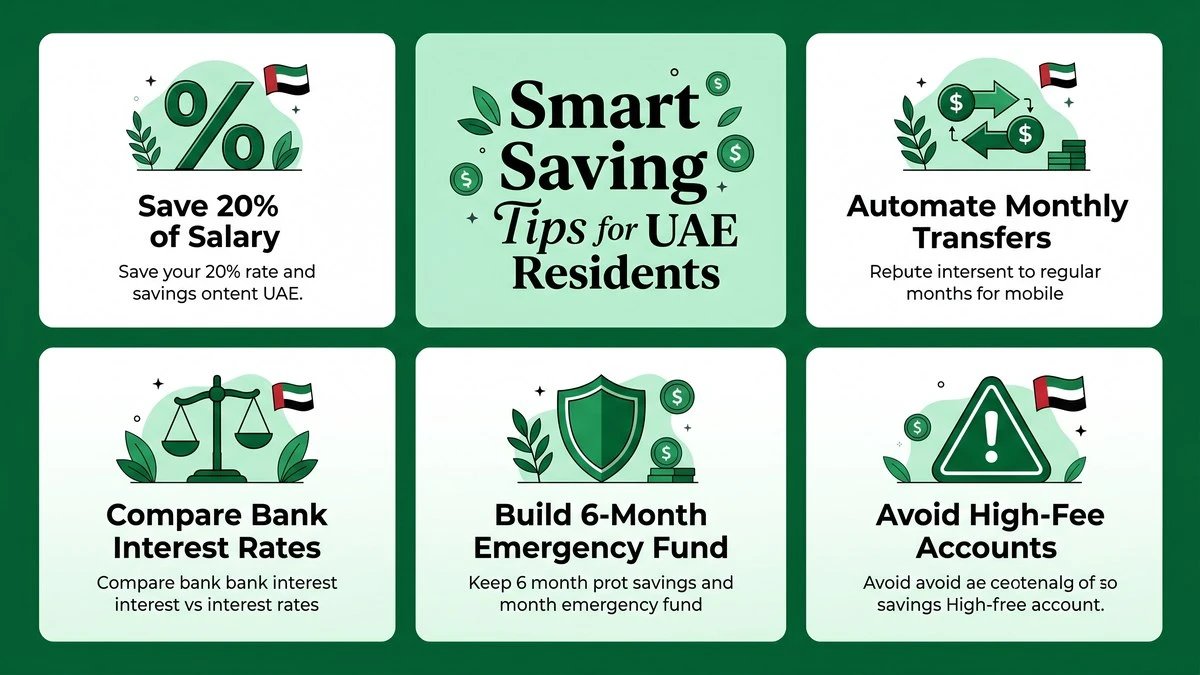
Use the calculator to set the target, then protect the plan with a few simple habits.
- Pay yourself first. Schedule the transfer the day your salary lands, not the day before next salary.
- Aim for 20% of salary. Adjust up or down based on rent and dependents.
- Keep an emergency cushion. Three to six months of essential expenses in an easy-access account.
- Compare interest rates yearly. If a better account opens up, switch.
- Avoid loan-funded saving. Saving while paying expensive loan EMIs is a leaky bucket.
If you’re also juggling debt repayments alongside savings, our UAE salary and loan EMI guide shows how much room your salary leaves for monthly savings.
Where to Park Your Monthly Savings
The calculator output is a number on a screen. Turning it into real wealth needs the right home for your AED.
- Standard savings account — flexible, easy access, modest interest.
- Goal-based or recurring savings account — encourages discipline, sometimes higher rates.
- Recurring deposit (RD) — fixed monthly contribution and term, set rate.
- High-interest digital savings account — managed via apps, often more competitive.
If you don’t want to lock funds, look at zero-balance accounts in the UAE and flexible saver accounts that pair well with monthly transfers. For higher-balance savers, a dedicated FAB iSave account is worth comparing too.
Frequently Asked Questions
Is a UAE savings calculator accurate?
What is a realistic savings interest rate in the UAE?
Is the calculator suitable for both AED salary earners and expats?
Does the calculator factor in inflation?
Can I use it for a fixed deposit instead of monthly saving?
How often should I revisit my savings plan?
Are my numbers stored when I use an online savings calculator?
Final Takeaway
A savings calculator is the cheapest financial advisor you’ll ever use in the UAE. In simple terms: it converts your monthly intent into a number you can chase, defend, and improve.
Start small if you must — even AED 300 a month, saved consistently, is a stronger habit than AED 3,000 saved once. Pair the calculator with a low-fee savings account, automate the transfer, and review it every six months. The numbers will follow.
Open the calculator, plug in your real figures, and lock in a target before the month ends. Future you will thank present you for it.
Sources
- Central Bank of the UAE — Consumer Awareness on Savings & Banking: https://www.centralbank.ae/en/consumer-awareness/
- UAE Government Portal — Personal Banking Information: https://u.ae/en/information-and-services/finance-and-investment
- SCA UAE — Investor & Saver Awareness Resources: https://www.sca.gov.ae/en/home.aspx
Last verified: May 2026. Always confirm interest rates and product terms with your bank before committing funds.
