
Buying a home in the UAE is exciting — until the numbers start showing up. Down payment, registration fees, EMIs, interest rates, insurance… it adds up fast. A home loan calculator gives you clarity in 30 seconds.
Here's the deal: before you sign anything with a bank or a developer, you need to know exactly what your monthly payment will look like, how much you can borrow, and whether the math actually fits your salary. This guide walks you through everything — the formula, the LTV rules, the real costs, and a working calculator you can use right now.
Why a Home Loan Calculator Matters in the UAE
Property in Dubai and the wider UAE is rarely cheap. Even a modest one-bedroom apartment in a mid-tier community can run into the millions. Without a calculator, most buyers underestimate the EMI and overestimate what they can afford.
A good calculator does three things at once:
- Tells you the monthly EMI for any property price and tenure.
- Shows total interest paid over the life of the loan.
- Highlights affordability against your monthly salary and existing obligations.
The result? Fewer surprises, better negotiation power with banks, and a realistic picture of what "owning a home in the UAE" actually costs each month. If you also want to check broader affordability first, our loan eligibility calculator for the UAE is a good starting point.
How a UAE Home Loan EMI Is Calculated
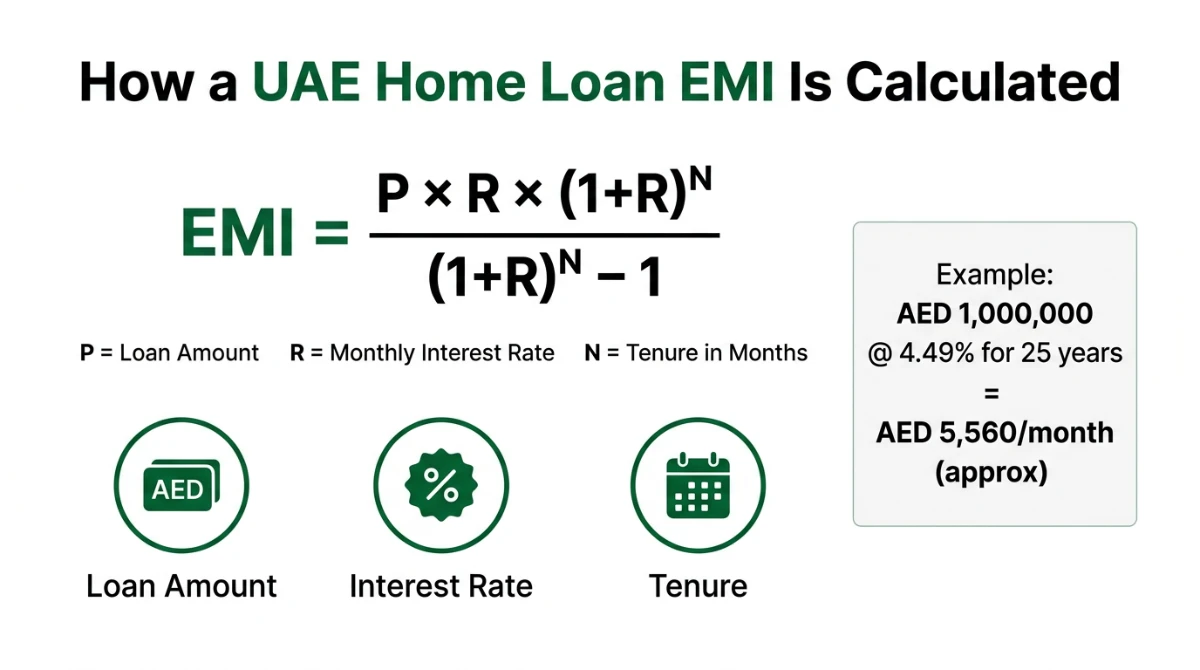
The math behind your monthly mortgage payment is the same across every bank — Emirates NBD, ADCB, FAB, Mashreq, HSBC, ENBD, or any other. They all use this formula:
EMI = P × R × (1+R)N / ((1+R)N − 1)
- P = Loan amount (in AED)
- R = Monthly interest rate (annual rate ÷ 12 ÷ 100)
- N = Total number of monthly instalments (years × 12)
Try Our UAE Home Loan Calculator
Skip the spreadsheet. Enter your numbers below and the calculator will instantly give you the monthly EMI, total interest, and total repayment.
Home Loan EMI Calculator
UAE Loan-to-Value (LTV) Limits You Should Know
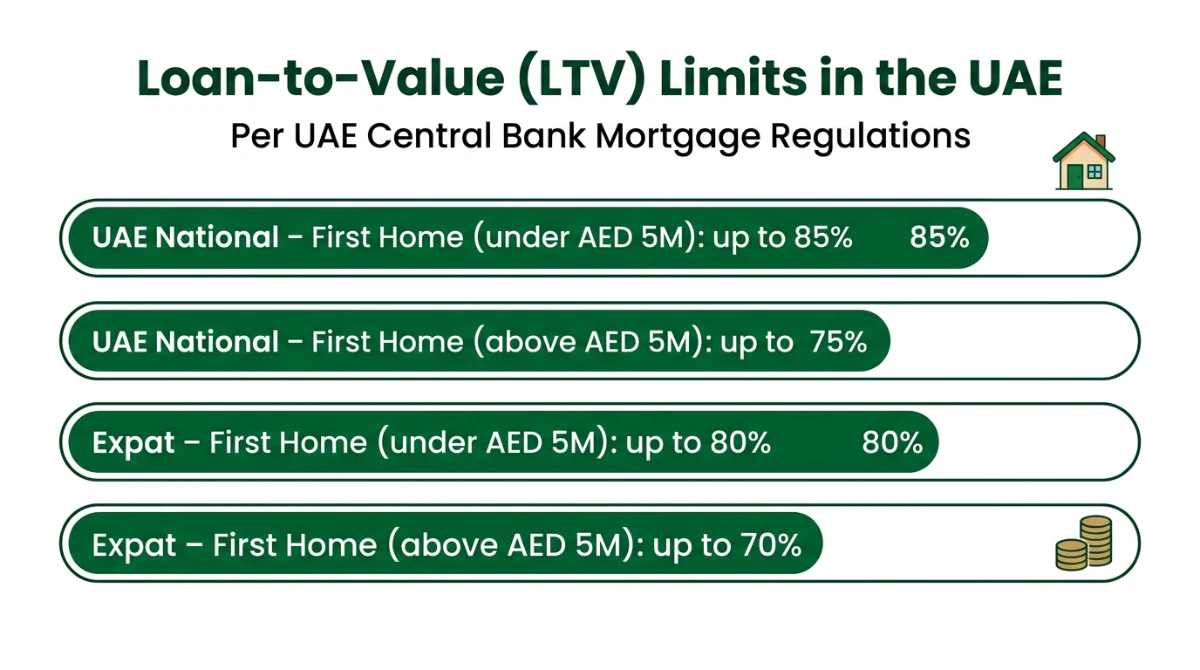
Banks in the UAE cannot lend you 100% of the property value. The UAE Central Bank caps how much you can borrow through Loan-to-Value (LTV) rules. The rest is your down payment.
| Buyer Type | Property Value | Maximum LTV | Minimum Down Payment |
|---|---|---|---|
| UAE National – First Home | Up to AED 5 million | Up to 85% | 15% |
| UAE National – First Home | Above AED 5 million | Up to 75% | 25% |
| Expat – First Home | Up to AED 5 million | Up to 80% | 20% |
| Expat – First Home | Above AED 5 million | Up to 70% | 30% |
| Second / Investment Property | Any value | Up to 65% | 35% |
| Off-Plan Property | Any value | Up to 50% | 50% |
The takeaway? Plug the right LTV into the calculator before assuming the bank will fund your full property price. Otherwise your EMI estimate will be way off.
Step-by-Step: How to Use the Home Loan Calculator
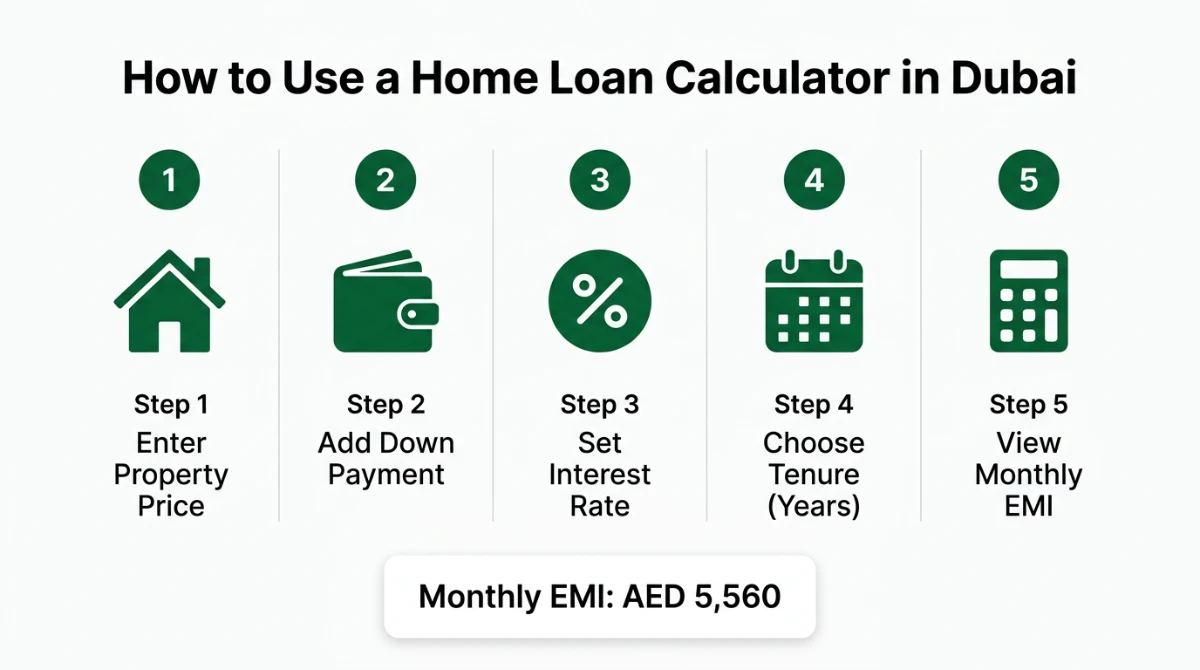
- Enter the property price — the asking price you've agreed with the seller or developer.
- Add your down payment — at least 20% if you're an expat buying your first home under AED 5M.
- Set the interest rate — pick the rate quoted by your bank. Use 4.49–5.49% as a working range if you don't have one yet.
- Choose the tenure — most UAE banks offer up to 25 years, with a few extending to 30 years for younger borrowers.
- Read your monthly EMI — and compare it against the 50% Debt Burden Ratio cap (more on that below).
Sample EMI Scenarios at Different Loan Sizes
Here's how monthly payments change across realistic Dubai property prices, assuming a 4.49% interest rate and 25-year tenure:
| Property Price | Down Payment (20%) | Loan Amount | Approx. Monthly EMI | Approx. Total Interest |
|---|---|---|---|---|
| AED 800,000 | AED 160,000 | AED 640,000 | AED 3,558 | AED 427,520 |
| AED 1,250,000 | AED 250,000 | AED 1,000,000 | AED 5,560 | AED 668,000 |
| AED 2,000,000 | AED 400,000 | AED 1,600,000 | AED 8,896 | AED 1,068,800 |
| AED 3,500,000 | AED 700,000 | AED 2,800,000 | AED 15,569 | AED 1,870,800 |
| AED 5,000,000 | AED 1,000,000 | AED 4,000,000 | AED 22,242 | AED 2,672,800 |
All figures are illustrative estimates for planning purposes. Always confirm the final EMI with the lender's official quote.
Fixed vs Variable Mortgage Rates in the UAE
UAE banks generally offer two flavours of home loans:
- Fixed-rate mortgages — the rate stays locked for 1, 3, or 5 years (sometimes longer). Predictable EMIs, easier budgeting.
- Variable-rate mortgages — usually tied to EIBOR (Emirates Interbank Offered Rate) plus a margin. EMIs move up or down as EIBOR changes.
Hidden Costs Every UAE Home Buyer Should Plan For
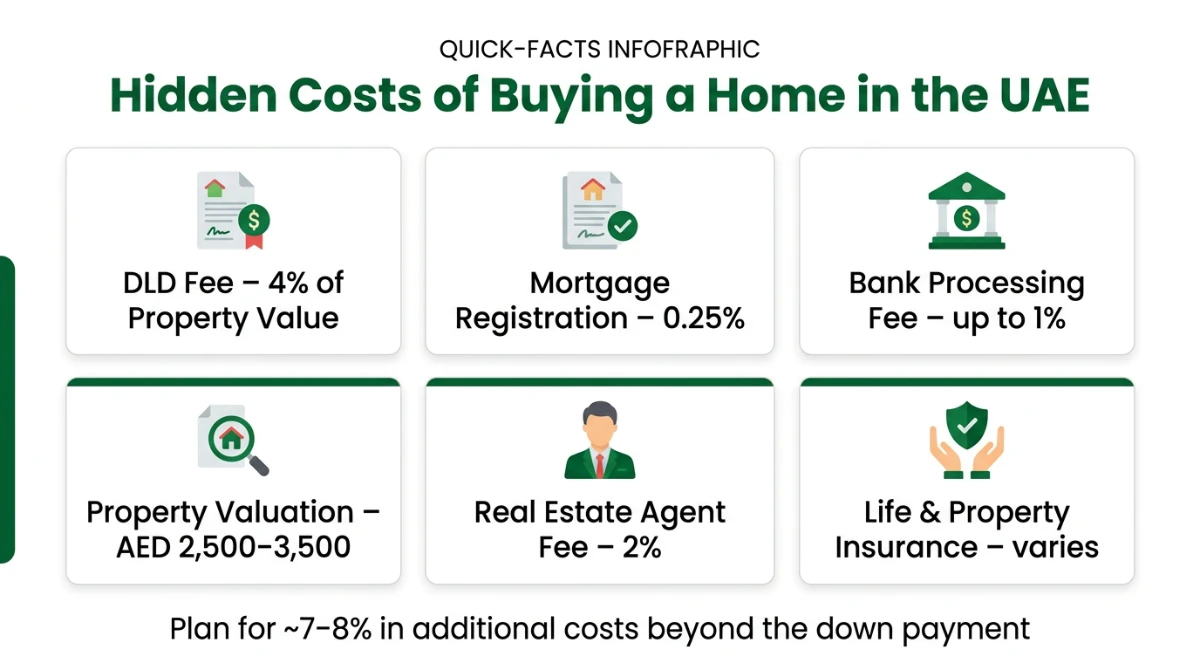
Your EMI is just the headline number. Buying a home in Dubai or any UAE emirate involves multiple one-time costs the calculator doesn't show by default.
| Cost | Typical Amount | Paid To |
|---|---|---|
| Dubai Land Department (DLD) Fee | 4% of property value + small admin | DLD / Land Department |
| Mortgage Registration Fee | 0.25% of loan amount + AED 290 | DLD |
| Bank Processing Fee | Up to 1% of loan amount | Lender |
| Property Valuation Fee | AED 2,500 – 3,500 (approx.) | Lender's valuer |
| Real Estate Agency Fee | ~2% of property value | Broker |
| Life & Property Insurance | Varies by age, loan size | Insurer (often via bank) |
| NOC Fee from Developer | AED 500 – 5,000 | Developer |
Bottom line: budget around 7–8% of the property price on top of your down payment for these one-off costs.
How Banks Decide If You Qualify for a Home Loan
Even with a perfect calculator output, the bank still applies its own filters. The big ones:
- Debt Burden Ratio (DBR): Your total monthly debt obligations (including the new EMI, credit card minimums, personal loan, car loan) cannot exceed 50% of your monthly income.
- Stable income: Most lenders ask for 6–12 months of employment with the current employer.
- Minimum salary: Usually starts around AED 15,000 per month for residents, higher for non-residents.
- Age cap: Loans must typically end by age 65 (salaried) or 70 (self-employed).
- Credit history: Your AECB credit report should be clean — no defaults or too many recent enquiries.
If you also have an active personal loan that's eating into your DBR, it might be worth checking whether a debt consolidation loan in the UAE can free up monthly cash flow before you apply for a mortgage.
Smart Ways to Lower Your Monthly EMI
If the calculator shows a number that scares you, don't give up — tweak the inputs:
- Increase the down payment. Even a 5% bigger down payment dramatically cuts the EMI.
- Extend the tenure. Going from 20 to 25 years lowers the monthly payment, though you pay more interest overall.
- Negotiate the rate. If you transfer your salary to the lender or are a long-time customer, ask for a better rate.
- Consider buy-out / refinance later. Many UAE banks offer buy-out loans at lower rates if interest rates drop.
- Improve your credit profile first. Clear small debts and reduce credit card utilisation before applying.
Common Mistakes UAE Home Buyers Make With the Calculator
- Using the property price as the loan amount (forgetting LTV and down payment).
- Plugging in a "promotional" 1-year fixed rate as if it applies for the full 25 years.
- Ignoring the 4% DLD fee — which alone can add tens of thousands to the upfront cost.
- Skipping life insurance premiums in the affordability check.
- Forgetting that EIBOR-linked variable rates will move during the loan tenure.
Frequently Asked Questions
It is accurate for the math itself — the EMI formula is universal. But the final EMI quoted by the bank can vary slightly because of insurance loading, processing fees being added to the principal, or different day-count conventions. Use the calculator for planning, then confirm with an official sanction letter.
For your first home, an expat can typically borrow up to 80% of the property value if it's under AED 5 million, and up to 70% if it's above AED 5 million. The remaining amount must be paid as a down payment. Second homes and investment properties are capped lower, around 65%.
Most UAE banks offer mortgages of up to 25 years, with some lenders extending to 30 years subject to age limits. As a rule, the loan must be fully repaid before you turn 65 if you are salaried, or 70 if you are self-employed. Younger borrowers therefore qualify for longer tenures.
Yes. The 4% Dubai Land Department fee is paid upfront and is separate from your down payment. It is calculated on the property value and is the responsibility of the buyer. Some banks allow part of it to be financed, but most expats end up paying it from their own savings at the time of transfer.
If you value predictable monthly payments and plan to hold the property short-to-medium term, fixed rates are easier. If you expect interest rates to fall and want to benefit from lower EMIs in the future, a variable rate tied to EIBOR can work in your favour. Many buyers split the difference by choosing a 3-year fixed period before reverting to variable.
Yes. UAE Central Bank rules cap the early settlement fee at 1% of the outstanding amount or AED 10,000, whichever is lower. Partial prepayments are also allowed and reduce your overall interest. Check your loan agreement for exact terms before paying down a large lump sum.
There's no fixed minimum, but most UAE lenders look for a salary of at least AED 15,000 per month for residents. Your eligibility ultimately depends on your Debt Burden Ratio — total EMIs plus the new mortgage cannot exceed 50% of your monthly income. So a higher salary or fewer existing debts widens your options.
By default, no. A standard home loan calculator only computes EMI on principal and interest. Life insurance, property insurance, and processing fees are usually paid separately or added to the loan principal. Always ask the bank for an "all-in" cost sheet before you compare offers.
Final Takeaway
A UAE home loan calculator is the single most useful tool you can use before house hunting in Dubai or any other emirate. In under a minute it tells you whether the property you're eyeing actually fits your salary, savings, and long-term plans.
The smartest approach: run the numbers before the bank does. Plug in realistic LTV limits, a conservative interest rate, and a sensible tenure. Layer the 4% DLD fee and other one-time costs on top. If the EMI still sits comfortably below 35–40% of your income, you're in good shape to start the application.
Ready for the next step? Compare your loan eligibility first, then approach 2–3 lenders with your numbers in hand. You'll negotiate harder, qualify faster, and pick the right loan with confidence.
- UAE Central Bank Rulebook – Article (3): Important Ratios — rulebook.centralbank.ae
- First Abu Dhabi Bank — Mortgage Loan for Residences (UAE) — bankfab.com
- Emirates NBD — Home Loans in Dubai and UAE — emiratesnbd.com
- ADCB — Standard Mortgage Home Loans in UAE — adcb.com
- HSBC UAE — Mortgage & Home Loan Interest Rates in Dubai — hsbc.ae
- Dubai Land Department — Fees & Mortgage Registration — dubailand.gov.ae
Last verified: May 2026. Interest rates, LTV ratios, and fees may change; always confirm the latest figures directly with the lender or the official authority before applying.
